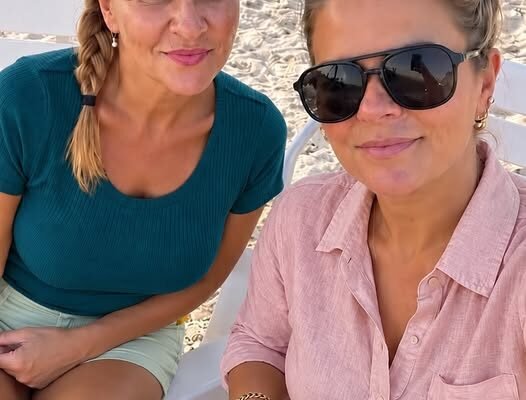
“I wasn’t trying to make a ceremony out of it,” Emily whispered.
“Then what were you doing?”
She looked down at her hands.
“Trying to have one photograph from before you knew.”
“Knew what?”
Her mouth opened.
Nothing came out.
I stood.
Thirty-seven years of friendship, and suddenly I couldn’t tolerate another unfinished sentence.
“Emily, either tell me now or I’m going back to the hotel.”
She looked up at me.
Tears were running down her face.
Then she said six words I could not make sense of.
“Claire, I think we’re half-sisters.”
I stared at her.
The ocean kept moving behind her.
People kept walking along the beach.
A little girl ran past carrying a pink bucket.
The entire world continued as though Emily had not just split mine open.
“What?”
“I said—”
“I heard you.”
I sat back down because my legs suddenly felt unreliable.
“No.”
Emily wiped her face.
“I know how impossible it sounds.”
“It doesn’t sound impossible. It sounds insane.”
“I know.”
“My father?”
She nodded.
I laughed.
Not because anything was funny.
“My father was George Bennett.”
“Yes.”
“He was married to my mother for forty-two years.”
“I know.”
“You knew him.”
“Yes.”
“He drove us to school when we missed the bus.”
Emily closed her eyes.
“I know.”
“He took you fishing with us.”
“I know.”
“He called you his second daughter.”
That one broke her.
Emily covered her face.
I stared at her.
Then another realization hit me.
“Daniel knew.”
She lowered her hands.
“Yes.”
The answer hurt more than the first revelation.
“How long?”
“Eleven years.”
I stood again.
“Eleven?”
“Claire—”
“My husband knew for eleven years?”
“Yes.”
“And you knew?”
“Thirteen.”
I backed away from her.
For thirty-seven years, Emily had known nearly everything about me.
For eleven of those years, she and my husband had shared a truth about my own life that I didn’t know.
“You two discussed this behind my back for eleven years?”
“It wasn’t like that.”
“Please don’t say that.”
She stopped.
“Don’t tell me something wasn’t what it looks like when you’ve had thirteen years to prepare your explanation.”
Her face collapsed.
“You’re right.”
I turned away.
“Is that why you were always at our house?”
“No.”
“Why Daniel treated you like family?”
“No.”
“Why you had a key?”
“No!”
The desperation in her voice made me turn back.
“I was your best friend before I knew any of this.”
She pressed one hand against her chest.
“I loved you before I knew.”
Something inside me twisted.
“Do you hear how strange that sounds?”
“Yes.”
“Like discovering we share DNA somehow changed what the first twenty-four years meant.”
“It didn’t.”
“Then why hide it?”
Emily looked toward the water.
“Because I was afraid it would change what they meant to you.”
I said nothing.
She reached into her beach bag.
Slowly.
Carefully.
Then she pulled out an old envelope.
It was yellowed at the edges.
“My mother gave me this thirteen years ago.”
Emily’s mother, Susan, had died the following winter.
I remembered those months.
I had helped Emily clear her mother’s apartment.
I had packed dishes.
Donated clothes.
Sat on the bathroom floor with her when grief became too much.
All while this envelope apparently existed.
“She was sick,” Emily continued. “She called me over one afternoon and told me there was something she should’ve told me years earlier.”
She handed me the envelope.
I didn’t take it.
“What?”
“My father wasn’t my biological father.”
I thought of Frank Miller.
Quiet Frank.
The man who built us a treehouse when we were nine.
The man Emily had buried at twenty-six.
“He knew?”
“Yes.”
That surprised me.
“He knew before he married Mom.”
Emily swallowed.
“She was already pregnant.”
My skin went cold.
“With my father’s child.”
“Yes.”
I finally took the envelope.
Inside was a letter written by Susan.
I recognized her handwriting immediately.
I didn’t read all of it.
I couldn’t.
I caught fragments.
George.
Summer of 1978.
A mistake.
Frank knew.
Frank chose to raise you.
Please don’t let biology diminish the father he was.
I folded the letter.
My hands were shaking.
“My parents married in 1978.”
“I know.”
“Was my father cheating on my mother?”
Emily looked miserable.
“I don’t know exactly.”
“You’ve had thirteen years to find out.”
“That was part of the problem.”
“What does that mean?”
“My mother claimed she and your father were together during a short period when he and your mother had separated before the wedding.”
I laughed bitterly.
“My parents never mentioned separating.”
“I know.”
“So somebody was lying.”
“Probably.”
That brutal honesty was somehow easier to hear than another excuse.
I looked down at the letter.
“How do you know your mother was telling the truth?”
“I didn’t.”
She reached into the bag again.
This time she removed a plastic folder.
Inside was a DNA report.
“I spent almost two years trying to prove her wrong.”
Emily had eventually contacted my father’s younger brother.
Uncle Raymond was still alive then.
She told him everything.
He agreed to a DNA test.
The result established a close biological relationship consistent with uncle and niece.
My stomach turned.
“Uncle Raymond knew?”
“After the test.”
“Did he tell Dad?”
“No. Your father had already died.”
Dad had been gone fourteen years.
Just one year before Emily learned the truth.
Another person unavailable to answer anything.
“How did Daniel get involved?”
Emily began crying again.
“I made a terrible decision.”
My pulse quickened.
“What decision?”
“I went to him.”
“Why him?”
“Because I couldn’t go to you.”
The answer made me furious.
“So you went to my husband?”
“Yes.”
“You thought he was a safer person to tell about my father than I was?”
“No.”
She shook her head.
“I thought he was the only person who would care about protecting you as much as I did.”
I wanted to reject that.
Part of me did.
But I knew Daniel.
And I understood exactly why someone frightened would have trusted him.
That didn’t make it right.
“What did he say?”
“The first thing?”
“Yes.”
“He said, ‘You have to tell Claire.’”
I stopped.
Emily gave a broken little smile.
“He was angry with me.”
“Good.”
“He told me I had no right to decide what truth you could handle.”
“Also good.”
“I said I needed time.”
“Eleven years?”
Her eyes dropped.
“No.”
“Apparently you did.”
“I kept postponing it.”
Birthdays.
Holidays.
My mother’s illness.
Emily’s divorce.
My twenty-fifth wedding anniversary.
There was always a reason tomorrow would be kinder than today.
Then time hardened around the secret.
“The longer I waited,” Emily said, “the worse telling you became.”
“And Daniel?”
“He kept asking me.”
“For eleven years?”
“Not constantly.”
She wiped her face.
“But he never let me pretend it was okay.”
My anger shifted slightly.
Not away from Emily.
Toward Daniel.
“He still kept your secret.”
“Yes.”
“From his wife.”
“Yes.”
Her voice was almost inaudible.
That betrayal was different.
Daniel and I hadn’t had a perfect marriage.
Nobody does.
But I had believed there were no locked rooms between us.
Apparently there had been one.
And Emily had been standing inside it with him.
I picked up my phone.
“I’m going back to the hotel.”
She nodded.
“Okay.”
“Don’t follow me.”
“I won’t.”
“And don’t call tonight.”
“I won’t.”
I walked several steps.
Then stopped.
“Tomorrow.”
Emily looked at me.
“What happens tomorrow?”
Her face went pale again.
“Daniel left you a letter.”
Everything inside me went still.
“What?”
“Your attorney is supposed to give it to you tomorrow morning.”
I remembered the appointment.
Mr. Harrison had called two weeks earlier.
He said Daniel had left a sealed personal document with instructions that it be delivered six months after his death.
I had assumed it was something sentimental.
Maybe anniversary letters.
Maybe instructions about the house.
“You know what’s in it.”
Emily nodded.
“Daniel told me before he died.”
That was why she had brought me to the beach.
Why she knew the truth was coming.
Why she wanted one final photograph before the letter changed everything.
I stared at the woman who had been beside me since second grade.
Then I said the cruelest truthful thing I had available.
“You should’ve trusted me before my dead husband had to tell me your secret.”
Emily bowed her head.
“Yes.”
I left her there.
I cried in the hotel shower.
Then I cried in bed.
Then I became angry enough that crying felt insulting.
I barely slept.
At nine the next morning, I was sitting in Mr. Harrison’s office.
He placed a cream-colored envelope in front of me.
Daniel’s handwriting was on the front.
CLAIRE — SIX MONTHS.
I ran my finger across his name.
For a moment, grief overwhelmed everything else.
The secret.
The beach.
Emily.
None of it mattered.
I just wanted my husband back.
Mr. Harrison quietly left the room.
I opened the envelope.
Claire,
If you’re reading this, then Emily has either finally told you or I have failed both of you by helping this secret live longer than it should have.
I stopped.
Even on paper, Daniel sounded like himself.
Direct.
No sentimental introduction.
I continued.
First, the thing I know your mind will try to invent:
I never had an affair with Emily.
I never wanted one.
She never wanted one.
She is not the hidden woman in our marriage.
She is the frightened woman who discovered that her best friend was also her sister and then became too afraid to risk losing either relationship.
I pressed the paper against my lips.
Sister.
Seeing Daniel use the word made it real in a way Emily’s DNA report hadn’t.
He continued.
When Emily told me, I insisted she tell you.
She asked for a few weeks.
I agreed.
That was my mistake.
Weeks became months.
Months became years.
Eventually, I told myself it was her truth to disclose.
That was partly true.
It was also convenient.
I loved both of you, and I was afraid forcing the issue would cost one of you the other.
So I helped preserve a peace built on an omission.
I am sorry.
My eyes blurred.
I had been angry at Daniel all night.
Now I was grieving him again.
Because this was exactly the kind of mistake he would make.
Not out of cruelty.
Out of trying to protect everyone.
Daniel’s greatest strength had sometimes been his worst habit.
He hated causing pain.
So occasionally he postponed pain until it became larger.
I kept reading.
You may be furious with Emily.
You may be furious with me.
Both are fair.
But please don’t let either anger rewrite thirty-seven years.
Emily didn’t become your sister thirteen years ago.
DNA simply gave a different name to something she had already been doing since you were seven.
She sat with you when your mother was sick.
She held our daughter before I did because I was stuck in hospital paperwork.
She slept on our couch after my surgery because you were exhausted.
And after my diagnosis, she was the person I asked to watch you after I couldn’t.
I stopped.
After my diagnosis.
I read the sentence again.
Daniel had known he was dying for four months before we told most people.
Emily had been there constantly.
I thought she was supporting both of us.
Apparently Daniel had also given her instructions.
The next paragraph shattered me.
I told her that if I died first, I wanted her to keep showing up until you became annoyed enough to tell her to go home.
She did.
I laughed through my tears.
That was exactly what had happened.
Two weeks after the funeral, I had told Emily:
You don’t have to bring me groceries every other day. I am capable of buying bread.
She returned three days later with bread.
Daniel continued.
Here is the part I want you to understand most:
Do not forgive either of us because I am dead.
Death does not make me automatically right.
If you’re angry with me, be angry.
I can take it.
Well, technically I can’t, but that’s finally one argument you cannot make me participate in.
I laughed again.
Then cried harder.
There was one final page.
Your father cannot explain himself.
Susan cannot explain herself.
Your mother may not have known.
There may never be a complete version of what happened in 1978.
Don’t spend the rest of your life trying to force dead people to finish old sentences.
Decide what Emily is to you based on the life you actually shared.
Not the circumstances that created either of you.
I loved you more than anyone.
And one of the things I loved most was the way you loved her.
Whatever you decide, make sure it is your decision.
Not mine.
Love,
Daniel
P.S. She is terrible at keeping secrets when she’s nervous. If she suggests taking a “final photograph,” please tell her I said she’s melodramatic.
I lowered the letter.
Then I laughed so hard I cried again.
Only Daniel.
Only my husband could reach across death to tease someone in the middle of detonating a family secret.
I sat there for nearly an hour.
Then I called Emily.
She answered immediately.
“Claire?”
“Where are you?”
“At the beach.”
Of course she was.
“Same place?”
“Yes.”
“I’m coming.”
I found her sitting beneath the same umbrella.
She stood when she saw me.
Then seemed unsure what to do with her hands.
For thirty-seven years, Emily had hugged me without asking.
That morning, she didn’t move toward me.
Good.
She understood something had changed.
I sat.
She sat.
For several minutes, neither of us spoke.
Then I placed Daniel’s letter between us.
“You knew he wrote all of this?”
“Not exactly what he wrote.”
“But you knew why.”
“Yes.”
I stared toward the water.
“I’m angry with you.”
“I know.”
“No. Listen.”
She nodded.
“I’m not angry because you’re my sister.”
Her face crumpled immediately.
I continued.
“I’m angry because you decided I couldn’t be trusted with the truth about my own life.”
Tears ran down her face.
“Yes.”
“And you went to my husband.”
“Yes.”
“And then both of you spent eleven years knowing something about me that I didn’t.”
“I know.”
“That makes me feel like an idiot.”
“You weren’t.”
“I know I wasn’t.”
That answer surprised both of us.
I repeated it.
“I know I wasn’t.”
Because the shame did not belong to me.
Emily nodded.
“You’re right.”
I looked at her.
“Don’t apologize by insulting yourself.”
She stopped.
“I need you to understand what actually hurt.”
“I’m listening.”
I took a breath.
“You made me the only person in my own marriage who wasn’t allowed inside that room.”
Emily closed her eyes.
“I know.”
“That will take me time.”
“You can have as much as you need.”
“And I may ask questions you can’t answer.”
“I’ll answer whatever I can.”
“And if you don’t know—”
“I’ll say I don’t know.”
“No protecting me.”
“No.”
“No deciding what I can handle.”
“Never again.”
I studied her face.
She looked exhausted.
Older somehow.
Then I asked,
“When did you first start thinking of me as your sister?”
Emily gave a tiny laugh.
“Before I knew.”
My throat tightened.
“That isn’t what I asked.”
She looked toward the water.
Then smiled through her tears.
“Probably when we were eight.”
“Why?”
“Because you punched Melissa Grant for calling me four-eyes.”
I stared at her.
“I did not punch her.”
“You shoved her into a hedge.”
“She tripped.”
“You yelled, ‘Nobody talks about my sister like that.’”
I remembered.
Not the exact words.
But enough.
I started laughing.
Emily did too.
Then we both cried.
Grief is strange.
So is love.
Sometimes they use the same doorway.
After a while, Emily reached into her bag.
My phone wasn’t there this time.
Her own phone was.
She looked at me.
“I won’t ask for a picture.”
“Good.”
“I deleted the one from yesterday.”
“You took one?”
“A selfie before everything went wrong.”
I stared at her.
“You are melodramatic.”
She almost smiled.
“Daniel said that too.”
“He specifically told me to tell you.”
For the first time since the beach conversation began, Emily laughed properly.
It sounded like the girl I had known since seven.
Then she became serious.
“What happens now?”
I looked at her.
“I don’t know.”
She nodded.
“Okay.”
That mattered.
She didn’t ask if I forgave her.
Didn’t ask whether we were still best friends.
Didn’t try to force thirty-seven years back into place before I was ready.
So I said the only thing I knew for certain.
“You’re not disappearing.”
Her face folded.
I continued.
“I may be angry with you tomorrow.”
“Okay.”
“I may be angry next month.”
“Okay.”
“And if you ever hide something from me for thirteen years again, I will personally throw you into the Atlantic.”
She laughed through her tears.
“Fair.”
Then I reached for her hand.
She stared at mine before taking it.
That small hesitation hurt.
But maybe it was supposed to.
Trust, once cracked, should not snap back into place simply because love is still there.
It should be rebuilt carefully enough that both people notice what they’re doing differently.
We spent the following months doing exactly that.
Emily answered everything I asked.
She gave me copies of Susan’s letter.
The DNA results.
Emails she’d exchanged with Uncle Raymond.
Notes she’d made after conversations with Daniel.
Nothing disappeared.
Nothing was softened.
I learned that my father had likely known Emily existed.
Whether he believed she was biologically his, we could never determine.
That hurt.
For several weeks, I became obsessed with finding certainty.
I searched old letters.
Photographs.
Calendars.
My mother’s journals.
There was no perfect answer.
Eventually, I understood Daniel’s warning.
Dead people leave unfinished sentences.
You can spend the rest of your life waiting for punctuation that will never come.
So I stopped.
Not because the past didn’t matter.
Because the present did.
A year after Daniel died, Emily and I returned to the beach.
Same town.
Different hotel.
We did not call it a healing trip.
At our age, we had developed enough sense to stop naming everything.
On our final afternoon, we walked along the shoreline.
Emily stopped.
“Claire?”
“What?”
She looked almost embarrassed.
“Would you take a picture with me?”
I stared at her.
“One final picture?”
She groaned.
“Never use those words again.”
I laughed.
Then handed a passing woman my phone.
Emily stood beside me.
For a second, neither of us knew how to pose.
Then she put her arm around my shoulder.
I did the same.
The woman took three photographs.
In the first, we were smiling politely.
In the second, Emily’s hair blew across my face.
In the third, we were both laughing.
That is the one I framed.
It sits beside a photograph of Daniel in my living room.
People occasionally ask whether finding out Emily was my sister changed our relationship.
Yes.
Of course it did.
But not in the way I expected.
For months, I thought biology had rewritten our friendship.
Eventually, I realized biology had arrived thirty-seven years late to a relationship that already knew what it was.
Emily had been there when I lost my first tooth.
My first boyfriend.
My mother.
My husband.
She had stood beside me through things DNA could neither create nor explain.
The secret hurt.
I will never pretend otherwise.
It took time before I trusted her completely again.
But forgiveness became possible because Emily never demanded that love erase what she’d done.
She allowed me to be angry.
She answered the uncomfortable questions.
And she learned something Daniel had tried to teach both of us.
Protecting someone from the truth is still deciding for them.
Today, Emily and I have known each other for forty-two years.
Sometimes I introduce her as my sister.
Sometimes as my best friend.
Usually she interrupts and says,
“Unfortunately, I’m both.”
And I tell her she talks too much.
There are still moments when I think about the thirteen years she kept the truth from me.
The hurt hasn’t vanished.
It simply no longer occupies the whole story.
Because the truth turned out to be larger than the betrayal.
My father may have given Emily and me the same blood.
But he didn’t make us family.
We did that ourselves.
One school bus ride.
One sleepover.
One heartbreak.
One funeral.
One terrible beach conversation at a time.
And the photograph Emily once feared would be our last as best friends?
I keep that one too.
Not because it captured an ending.
Because it reminds me how wrong both of us were about what the truth would destroy.
It didn’t end our story.
It finally allowed us to stop living around the part we were afraid to tell.