I turned to him.
“What?”
Emma’s fiancé, Noah, stood a few feet behind me.
He had gone completely still.
The woman looked at him.
For the first time since she arrived, the bitterness disappeared from her face.
“Noah.”
He closed his eyes.
“Please don’t do this here.”
My confusion deepened.
“You know her too?”
Noah looked at Emma.
Emma reached for his hand.
Then he looked at me.
“Yes.”
“Who is she?”
The woman answered before he could.
“I’m his mother.”
Nobody moved.
I stared at her.
Then at Noah.
Then back at David.
“His mother?”
Noah’s parents were dead.
At least, that was what I had always understood.
He had been raised by his grandparents after his mother died when he was young.
I looked at Emma.
“You told me his mother died.”
“No,” Noah said quietly. “I told you the woman who raised me died.”
My mind raced backward through three years of conversations.
Photographs.
Christmas dinners.
Stories about his grandmother, Helen.
I had simply assumed.
Noah had never corrected me.
The woman gave a humorless laugh.
“Helen was my mother.”
Noah’s jaw tightened.
“She was my mother in every way that mattered.”
The woman flinched.
And suddenly I understood that whatever this was, it went back much further than a wedding cake.
“What is your name?” I asked.
She hesitated.
“Marianne Cole.”
“Then why are you telling people your name is Laura Mitchell?”
Her face changed.
She glanced toward the entrance.
“I wanted them to listen.”
“That doesn’t answer my question.”
Noah stepped forward.
“She’s been doing this for months.”
Emma squeezed his hand.
I stared at my daughter.
“You knew?”
She nodded slowly.
“We were trying to handle it.”
“Handle what?”
Noah took a breath.
Then he told me.
Marianne had left when he was four years old.
Not died.
Left.
She had struggled with addiction for years, disappeared for long stretches, returned with promises, and disappeared again.
Eventually, Helen and her husband obtained legal guardianship.
They raised Noah.
They attended his school plays.
Taught him to drive.
Paid for college applications.
Sat in the front row when he graduated.
Marianne drifted in and out of his life.
Sometimes she called on birthdays.
Sometimes she vanished for years.
When Helen died, Noah finally stopped pretending the relationship could be repaired simply because Marianne was his biological mother.
Then he met Emma.
They got engaged.
And somehow Marianne learned about the wedding.
“At first she just wanted an invitation,” Noah said.
“I told her no.”
Marianne folded her arms.
“I’m your mother.”
Noah looked at her.
“You gave birth to me.”
The words were quiet.
They hurt more because he didn’t shout them.
Marianne looked away.
Noah continued.
“She started contacting Emma.”
I looked at my daughter.
Emma nodded.
“Messages. Calls. New numbers whenever we blocked one.”
“Why didn’t you tell me?”
“Because you were already doing everything for the wedding.”
“That’s exactly why you should have told me.”
“I know.”
David finally spoke.
“She contacted me too.”
I turned toward him.
“So that’s why you were with her at the bakery.”
He nodded.
Three weeks earlier, Marianne had apparently called David.
She claimed she only wanted five minutes with Noah.
She promised she wasn’t trying to ruin anything.
David, believing he might be able to calm the situation without involving me, agreed to meet her.
He chose the bakery because he was already scheduled to drop off the antique cake topper from my parents’ wedding that Emma wanted incorporated into the display.
Marianne followed him inside.
The baker remembered seeing them together.
“You should have told me,” I said.
“I know.”
“No, David. You let me spend an entire night thinking you were having an affair.”
“I know.”
His voice cracked.
“And I am so sorry.”
He stepped toward me.
“I thought I was protecting you from one more problem.”
I shook my head.
“You don’t protect your wife by keeping her in the dark.”
“No.”
He didn’t argue.
“I was wrong.”
That softened something in me.
Not completely.
But enough.
I looked back at Marianne.
“So what happened yesterday?”
Noah answered.
“She found out the bakery had instructions to release the cake to you.”
Marianne said nothing.
Emma looked at her.
“You called pretending to be me.”
Marianne finally spoke.
“I wanted someone to notice me.”
Noah stared at her.
“So you tried to stop our wedding cake?”
“I wasn’t going to destroy it.”
“You told them not to give it to Emma’s mother.”
“I wanted you to call me.”
“You could have called me yourself.”
“You blocked me.”
“Because you wouldn’t stop.”
Marianne’s face collapsed for just a second.
There it was.
Not anger.
Pain.
But pain didn’t erase what she had done.
That was something it had taken me years to understand.
Someone can be hurting and still hurt other people.
One does not excuse the other.
I stepped between Marianne and the ballroom entrance.
“This is my daughter’s wedding day.”
She looked at me.
“I know.”
“No. I don’t think you do.”
My voice remained calm.
“Whatever happened between you and Noah happened long before Emma entered his life. Whatever you regret, whatever you wish you could change, you do not get to use their wedding as your opportunity to force a reconciliation.”
Her eyes filled.
“I just wanted to see my son get married.”
Behind me, Noah whispered,
“You could have.”
Marianne turned toward him.
He swallowed.
“If you had respected one boundary.”
She stared at him.
“I asked you to give me time. I didn’t say never.”
Her mouth trembled.
“I thought never was what you meant.”
“Then you should’ve asked.”
“I tried.”
“No. You demanded.”
Silence.
Noah’s voice became quieter.
“You called Emma names. You threatened to show up. You contacted her vendors. Yesterday you impersonated her mother.”
He shook his head.
“That isn’t asking.”
Marianne wiped her face.
“I don’t know how to fix this.”
Noah looked at her for a long time.
“Not today.”
She froze.
He continued.
“That’s how you start.”
Marianne’s shoulders dropped.
“By leaving?”
“By letting today belong to us.”
I watched something change in her expression.
Maybe she had arrived expecting a fight.
Maybe she had expected Noah to throw her out.
Maybe anger was easier for her than hearing him calmly explain exactly what he needed.
“Will you talk to me afterward?” she asked.
Noah looked at Emma.
Emma didn’t answer for him.
I appreciated that.
After a few seconds, Noah said,
“Not tomorrow.”
Marianne nodded.
“Okay.”
“Not next week.”
Another nod.
“I understand.”
“When I’m ready.”
Her eyes filled again.
“Okay.”
Then Noah surprised all of us.
He walked toward her.
Not close enough for an embrace.
Just closer.
“I don’t hate you.”
Marianne covered her mouth.
“But loving somebody doesn’t mean giving them unlimited access to your life.”
She nodded through tears.
“I know.”
“I hope someday you really do.”
A venue employee approached cautiously.
“Should I call security?”
Noah shook his head.
“No.”
Then he looked at Marianne.
“She’ll leave.”
For a moment, I wondered whether she would.
Then Marianne reached into her purse.
She removed a small white envelope.
She held it toward Noah.
“I brought this for you.”
He didn’t take it.
“What is it?”
“Just a letter.”
He hesitated.
Then accepted it.
“No surprises?”
“No.”
“No money?”
“No.”
“No guilt?”
A sad smile appeared.
“I’m trying.”
Noah slipped the envelope into his jacket.
“I’ll read it when I’m ready.”
Marianne nodded.
Then she looked at Emma.
“I am sorry.”
Emma held Noah’s hand tighter.
“For yesterday?”
“For all of it.”
Emma didn’t say she forgave her.
She simply said,
“Thank you for apologizing.”
And somehow that seemed exactly right.
Marianne turned toward me last.
“I’m sorry I used your name.”
I almost laughed.
“Of all the things that happened this weekend, I’m strangely relieved that identity theft is the easiest one to explain.”
David made a choking sound that was either a laugh or an attempt not to laugh.
Even Noah smiled.
Marianne did too.
Just for a second.
Then she left.
We watched through the glass doors as she crossed the parking lot.
Nobody followed her.
Nobody begged her to stay.
Nobody tried to turn the moment into something it wasn’t.
Sometimes love means opening a door.
Sometimes it means allowing someone to walk through it in the opposite direction.
When she disappeared from view, I turned toward David.
He looked terrified.
“We’re not finished,” I said.
“I assumed not.”
“You owe me a very long conversation.”
“I know.”
“You let me think you had another woman.”
“In retrospect—”
“David.”
“Right. Not helping.”
Emma laughed.
It was the first time I’d heard her laugh all morning.
Then suddenly she stopped.
“Oh my God.”
“What?”
“The cake.”
We all looked toward the reception hall.
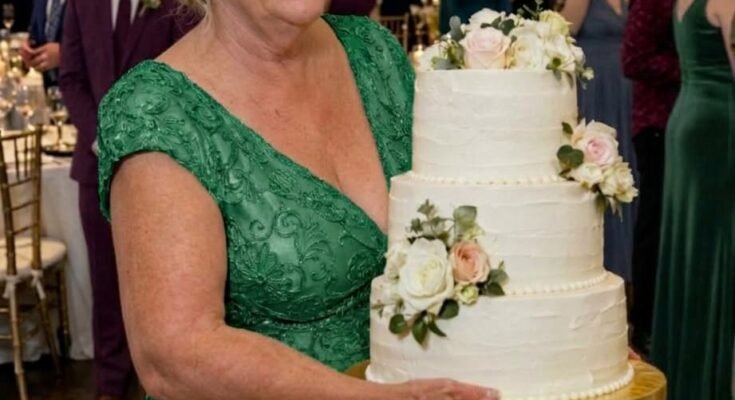
The enormous three-tier wedding cake was still sitting on its rolling cart where the staff had placed it.
Perfect.
White buttercream.
Tiny handmade flowers.
The antique porcelain topper from my parents’ wedding resting on top.
After everything that had happened, that ridiculous cake was still immaculate.
Emma started laughing again.
Then I did.
Soon Noah was laughing.
Even David.
Maybe it was exhaustion.
Maybe relief.
Maybe human beings can only absorb so much drama before something ordinary becomes hilarious.
Emma wiped her eyes.
“Mom, you almost lost my wedding cake.”
“I did not lose your cake.”
“You were specifically prohibited from possessing it.”
“I’ve never been banned from baked goods before.”
Noah grinned.
“There’s a first time for everything.”
A coordinator appeared from the ballroom.
“Emma?”
My daughter turned.
“We’re ready whenever you are.”
The laughter faded.
And suddenly everything changed.
My little girl was standing in front of me wearing her wedding dress.
For months, I had worried about flowers.
Napkins.
Guest lists.
Music.
Seating charts.
Cake flavors.
I had spent that morning worrying about betrayal.
Secrets.
A strange woman using my name.
But looking at Emma, none of it mattered.
She was beautiful.
Not magazine beautiful.
Not perfect-hair-and-makeup beautiful.
She looked happy.
That was better.
I reached up and fixed one loose strand of hair near her cheek.
“Ready?”
Emma looked at Noah.
He smiled.
Then she looked back at me.
“I am.”
Noah left to take his place.
David started to follow.
I caught his arm.
He stopped.
“We talk tomorrow,” I said.
“All day if necessary.”
“And next time you think protecting me means hiding something from me—”
“I tell you.”
“Immediately.”
“Immediately.”
I narrowed my eyes.
“Even if it’s terrible.”
“Especially if it’s terrible.”
I let go.
Then, because thirty-two years of marriage mattered more than one terrible night, I straightened his tie.
“You look nervous.”
“My wife almost accused me of adultery at our daughter’s wedding.”
“You froze when I showed you another woman’s phone number.”
“Yes.”
“You said, ‘Please don’t do this tonight.’”
“Yes.”
“That is exactly what guilty people say.”
“I understand that now.”
“You’re lucky I love you.”
He smiled.
“I know.”
Then he kissed my forehead.
“I love you too.”
Twenty minutes later, music filled the room.
David walked Emma down the aisle.
I sat in the front row.
When Noah saw her, his entire face changed.
There are moments when you know you’re witnessing something true.
That was one.
He wasn’t looking at the dress.
He wasn’t looking at the flowers.
He was looking at Emma as if every difficult thing he had survived had somehow led him to that exact room.
David placed Emma’s hand into Noah’s.
Before sitting down, he leaned toward him.
I couldn’t hear what he said.
Later, Noah told me.
David had whispered,
“You don’t have to be perfect. Just don’t make her face the hard things alone.”
Noah answered,
“I won’t.”
I cried through most of the ceremony.
Not because of what had almost gone wrong.
Because I suddenly understood how many different kinds of family were sitting in that room.
People who were related by blood.
People who weren’t.
People who had stayed.
People who had failed and were trying to do better.
And two young people standing in the middle of all of it, promising to build something of their own.
At the reception, the cake became famous.
Everyone had already heard some version of the story.
By dessert, people were calling it the hostage cake.
My brother wanted to know whether we needed police protection before cutting it.
Emma threatened to remove him from the guest list retroactively.
When she and Noah finally sliced into it, the entire room applauded.
I stood beside David.
He took my hand.
“Chocolate?”
“Vanilla raspberry.”
“You sure?”
“I ordered the thing.”
He smiled.
“Apparently that doesn’t mean they’ll release it to you.”
I elbowed him.
Later that evening, Noah found me sitting alone outside the ballroom.
The music was loud inside.
Emma was dancing with her friends.
He sat beside me.
“Thank you.”
“For what?”
“For not making today about Marianne.”
I looked at him.
“I nearly made it about your future father-in-law’s imaginary affair.”
He laughed.
“Fair.”
Then his expression became serious.
“I should’ve told you.”
“You didn’t owe me your whole history, Noah.”
“But Emma did.”
“No.”
I shook my head.
“She owed me honesty when the situation started affecting us. That’s different.”
He considered that.
Then nodded.
“I’m still figuring out where all those lines are.”
“We all are.”
He stared through the glass doors toward Emma.
“I kept thinking if I ignored Marianne long enough, she’d disappear.”
“Did that work?”
He smiled faintly.
“Not especially.”
“No.”
I touched his arm.
“You’re allowed to love someone and still require them to behave differently before they can be part of your life.”
His eyes became wet.
“I wish someone had told me that when I was ten.”
“I’m telling you now.”
He looked at me.
Then he hugged me.
It wasn’t a dramatic moment.
Nobody saw it.
There was no photographer nearby.
But it became one of my favorite memories from the entire wedding.
Because when he released me, Noah said,
“I’m glad Emma has you.”
I smiled.
“You do too now.”
His face changed.
Just slightly.
But enough.
Later that night, Emma tossed her bouquet.
My seventy-three-year-old aunt caught it.
She immediately threw it back.
David and I danced until my feet hurt.
And sometime around midnight, I looked across the room and saw Emma resting her head on Noah’s shoulder.
That was when the fear I’d carried all day finally disappeared.
The wedding wasn’t ruined.
The cake wasn’t ruined.
Our family wasn’t ruined.
We had simply discovered, in one incredibly stressful twenty-four-hour period, that families sometimes carry secrets because they think silence keeps everyone safe.
It doesn’t.
Silence creates empty spaces.
And eventually fear fills them.
I thought my husband was having an affair because he wouldn’t tell me the truth.
Noah spent years believing boundaries made him cruel because nobody taught him otherwise.
Emma thought protecting her fiancé meant carrying his problems alone.
And Marianne believed forcing her way into someone’s life was the same as fighting for a relationship.
We were all wrong in different ways.
Six months later, Noah finally read Marianne’s letter.
He didn’t tell us everything it said.
That belonged to him.
But eventually, with the help of a counselor, he agreed to meet her for coffee.
One hour.
Public place.
No promises.
Emma went with him but waited outside.
That first conversation didn’t repair twenty years.
Neither did the second.
But Marianne kept showing up when invited.
She stopped calling from new numbers.
Stopped contacting Emma.
Stopped appearing unexpectedly.
She learned that respecting Noah’s boundaries was the only way she might eventually be trusted inside them.
Two years later, when Emma and Noah had their first baby, Marianne met her granddaughter.
She didn’t arrive at the hospital.
She didn’t demand anything.
She waited until Noah invited her.
I was there.
She stood in our living room holding that tiny baby with tears streaming down her face.
Then she looked at Noah.
“Thank you.”
He nodded.
Nothing more needed to be said.
David and I changed too.
We made a rule after the wedding.
No protective secrets.
If one of us knew something that directly affected the other, we talked about it.
Even when it was uncomfortable.
Especially then.
Every year on Emma and Noah’s anniversary, I send them a photograph of their wedding cake.
Emma always replies with the same message.
Still can’t believe you almost got banned from my wedding by a cake shop.
And I always respond:
Still can’t believe you sent your mother to pick up a cake without warning her she had an impersonator.
Last year she finally wrote back:
Fair.
But when I think about that wedding now, I don’t think about the mysterious phone number.
I don’t think about the night I wondered whether my marriage was falling apart.
I don’t even think about Marianne standing downstairs.
I remember Noah seeing Emma walk down the aisle.
I remember David squeezing my hand.
I remember a young man who had spent years wondering whether family was something you were trapped inside discovering that family could also be something you chose.
And I remember the cake.
Because in the end, I did exactly what my daughter originally asked me to do.
I gave them my name.
I picked up the cake.
And despite everything that tried to get in the way, I carried it safely to the beginning of their new life together.