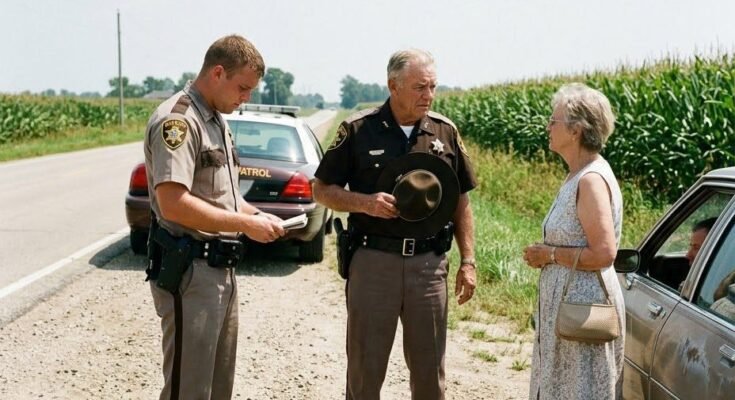
A deputy stopped my 71-year-old mother on County Road 6, left her standing beside the car in ninety-one-degree heat for forty minutes, then laughed at her temporary license and said it looked homemade.
Mom never argued.
She only asked him one quiet question.
“Deputy, would you mind saying my name over your radio?”
It was ninety-one degrees that afternoon.
There was no shade anywhere along that stretch of road.
Just cornfields on both sides, tall and thick enough to make the highway feel like a narrow corridor.
I was sitting in the passenger seat with a pan of lemon bars resting across my knees.
Mom was driving.
She had never been a fast driver.
Forty-eight in a fifty-five was normal for her.
Then the patrol car appeared behind us.
The lights came on.
Mom pulled over immediately.
The deputy approached wearing sunglasses.
He didn’t say hello.
Didn’t explain why he had stopped us.
“License and insurance.”
Mom opened her handbag and handed him the temporary paper license the courthouse had issued while she waited for the permanent card to arrive.
It was printed on yellow paper.
The deputy held it between two fingers.
Lifted it toward the sun.
Then gave a small smile.
“What’d you do, print this at the library?”
He laughed softly at his own joke.
Mom didn’t react.
He looked at the paper once more.
“Step out of the vehicle, ma’am.”
She did.
Seventy-one years old.
Summer dress.
Handbag still looped around her arm.
He pointed toward the back of the car.
“Stand over there where I can see you.”
I leaned toward my window.
“She’s seventy-one years old.”
The deputy bent slightly and looked inside.
“Sir, stay in your seat.”
I put my hand on the door handle.
Mom looked straight at me.
“Stay there, Jeffrey.”
So I stayed.
The deputy returned to his cruiser.
His engine remained running.
Windows closed.
Air conditioner on.
Mom stood outside in the August heat.
Ten minutes passed.
Then twenty.
I watched her through the side mirror.
She didn’t lean against the Buick.
The metal was probably too hot anyway.
At thirty minutes, she finally asked,
“Officer, may I sit inside while we wait?”
He stepped out of the cruiser.
“You can sit when I tell you.”
Then he went back inside.
By then, the powdered sugar on the lemon bars had melted into a wet glaze.
And there is something about that afternoon I still feel ashamed of.
Mom had worked nights in the basement of the county courthouse for thirty-four years.
Whenever someone asked what she did, I usually said,
“She answers phones.”
I made it sound insignificant.
Almost like I was embarrassed by it.
So while she stood there on the shoulder, part of me assumed the deputy saw her the same way.
Just an old woman.
A temporary paper license.
Nobody worth taking seriously.
After forty minutes, the deputy finally came back.
This time, he had a ticket book in his hand.
“I’m going to write this up.”
Then he added,
“Might have the vehicle towed too.”
Mom looked at him.
“Deputy, may I ask you something first?”
He gave another little smile.
“Go ahead.”
“Would you press the button on your radio and say my name?”
He frowned.
“My name only,” Mom said. “Shirley Hagen.”
The deputy glanced through the rear window at me.
Then grinned.
“You think that name means something?”
Mom shook her head.
“No. I don’t think I’m important.”
I wanted to disappear into the passenger seat.
The deputy apparently thought she was trying to impress him.
So he decided to play along.
He pressed the microphone on his shoulder.
“Dispatch, I’ve got a lady out here with what looks like a homemade temporary license. She wants me to say her name.”
He looked at Mom.
“Shirley Hagen.”
Then he released the button.
And laughed.
The radio stayed silent.
Not normal silence.
The strange kind.
The kind that makes you wonder whether everyone listening has suddenly stopped what they were doing.→ Three seconds felt like three years.
Then the radio on the deputy’s shoulder exploded with static. It wasn’t the bored, monotone dispatcher who usually rattled off license plates. It was Brenda, the county’s senior head of communications, and her voice carried the kind of sharp, terrifying tremor that froze the air.
“Unit Twelve, repeat that last transmission immediately. Confirm subject name.”
The deputy’s smile faltered. He tapped the mic again, his tone losing a fraction of its arrogance. “Uh, Dispatch, subject is Shirley Hagen. Operating on an unverified paper slip—”
Before he could finish, a loud click overrode the frequency. A different voice cut in.
It was deep, gravelly, and unmistakably Sheriff Miller himself.
“Miller to Unit Twelve. Where are you?”
The deputy blinked, his sunglasses sliding slightly down the bridge of his nose. “Mile marker nine, Sheriff. County Road 6.”
“Miller to all available units: clear the channel,” the Sheriff barked, his voice vibrating through the cruiser’s open door. “Unit Twelve, step away from that woman. You do not touch her, you do not write a citation, and God help you if you laid a finger on her. Get Miss Shirley back into her vehicle with the air conditioning running right now. I am six minutes out.”
The channel clicked dead.
The deputy’s mouth hung open. The smugness drained from his face until his skin looked as pale as chalk. He stared at Mom, his hands suddenly trembling around the metal edge of his ticket book.
“Ma’am…” he stammered, stepping back toward the cruiser, his voice squeaking. “Ma’am, please… please sit in the car.”
Mom didn’t move. She just smoothed the front of her cotton dress, adjusted the handbag on her forearm, and looked at him with calm, patient eyes.
“No, thank you, Deputy,” she said softly. “You told me to stand here until you told me I could sit. I wouldn’t want to disobey an officer.”
The next four minutes were deafeningly quiet. The deputy stood on the hot gravel, shifting his weight from boot to boot, sweat pouring down his sideburns. He kept wiping his forehead, looking up the empty asphalt of County Road 6 like a condemned man waiting for the executioner.
Then the siren wailed in the distance.
A midnight-blue cruiser tore around the bend, kicked up a storm of dust and gravel, and slid to a halt right behind the patrol car. The door flew open before the vehicle had even completely stopped rolling.
Sheriff Tom Miller stepped out. He didn’t look at the young deputy. He walked straight toward Mom, his heavy boots crunching against the shoulder. When he reached her, he took off his hat, his weathered face filled with pure mortification.
“Miss Shirley,” Tom said, his voice dropping into quiet reverence. “Are you all right? Please tell me you’re all right.”
“I’m fine, Tommy,” Mom said, offering a faint, tired smile. “Just a little warm. My son Jeffrey had some lemon bars, but I think the heat got to them.”
I sat frozen in the Buick, my jaw dropped. Tommy? The county’s most feared lawman, who had held office for sixteen years, was standing on the gravel road like a boy caught skipping Sunday school.
Sheriff Miller turned around. The gentleness disappeared instantly. His gaze locked onto the young deputy, and his eyes went dead and black.
“Forty minutes, Evans?” Miller’s voice was dangerously low, carrying over the hum of the cornfields. “You left Miss Shirley standing on the blacktop for forty minutes?”
“Sheriff, I—I thought her license was fraudulent,” Evans stammered, swallowing hard, clutching the radio at his chest. “She had a yellow slip, and she said—”
“You arrogant little fool,” Miller growled, stepping into Evans’ space until their chest badges almost touched. “When you broke your leg in the academy yard twelve years ago and your own father wouldn’t pick up the phone, who stayed on the night line with you until the medics arrived? When half the deputies in this county went through family hell, who took every midnight call, tracked every emergency patch, and held the entire administrative spine of this department together for thirty-four years before you even learned to tie your boots?”
Evans stared at Mom in utter horror.
“Miss Shirley doesn’t just ‘answer phones,’” the Sheriff snapped. “She literally built the night dispatch desk from scratch before the courthouse even had computers. Every senior officer, magistrate, and judge in this territory owes her their sanity. And you left her to bake in ninety-degree sun over a state clerk’s yellow renewal slip.”
Sheriff Miller reached out, ripped the clipboard and ticket book straight out of Evans’ hands, and threw it onto the hood of the cruiser.
“Give me your keys,” Miller said flatly.
“Sheriff, please—”
“Keys. Now. You’re riding back in my passenger seat. Miss Shirley’s vehicle is not getting towed. Tomorrow morning at seven, your uniform will be turned in, and you will spend the next three months reassigned to filing paper permits in the courthouse basement. Maybe then you’ll learn what real work looks like.”
Deputy Evans unclipped his cruiser keys with trembling fingers, handed them over without looking up, and walked toward the Sheriff’s cruiser with his head bowed in complete humiliation.
Sheriff Miller turned back to Mom, his stern expression softening once more. He reached into his cruiser, pulled out two cold bottles of water, and handed one to Mom and one through the window to me.
“I am so sorry, Miss Shirley,” he said, pressing her hand between both of his. “If you need anything—a ride home, an ambulance to check your vitals—say the word.”
“Just an apology from the boy, Tommy,” Mom replied gently. “He didn’t know. Pride just gets ahead of young men sometimes.”
“He’ll apologize to you in writing every morning before his desk shift begins,” Miller promised. “Now let me escort you two home so Jeffrey can get you some cold sweet tea.”
Ten minutes later, the blue lights were flashing ahead of us—not to pull us over, but leading us smoothly down County Road 6 toward town.
I looked over at my mother from the passenger seat. She was driving forty-eight in a fifty-five, both hands placed neatly at ten and two, sipping her cold water as the Buick’s air conditioning hummed gently.
I reached down, touched the warm pan of melted lemon bars on my lap, and swallowed the lump in my throat. I would never, for the rest of my life, tell anyone that my mother just answered phones.
A deputy stopped my 71-year-old mother on County Road 6, left her standing beside the car in ninety-one-degree heat for forty minutes, then laughed at her temporary license and said it looked homemade.