
Part 1: The Checkout
“I know I brought it.”
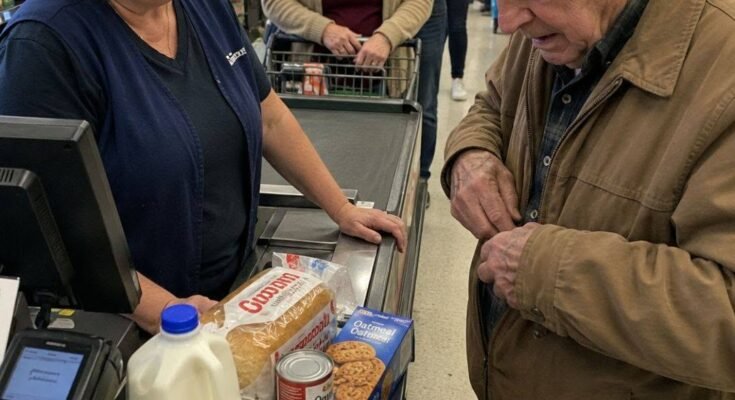
The elderly man said it for the third time, but this time his voice cracked. He stood at Sheryl Ames’s checkout lane with both hands buried in the pockets of a faded brown jacket, searching for a wallet that clearly wasn’t there. Behind him, the line was growing. A woman shifted her basket from one hip to the other. Someone farther back sighed. The register screen showed $42.18.
The man looked at the groceries he had already placed in bags. Bread. Milk. Bananas. A can of soup. Dog food. A small package of oatmeal cookies. Nothing extravagant.
“I had my wallet when I left the house,” he whispered.
Sheryl looked at his face. And immediately recognized the look in his eyes. Not ordinary forgetfulness. Not embarrassment over leaving a wallet on the kitchen counter. It was the frightened expression of someone suddenly realizing the world had moved half a step away from him.
Sheryl knew that look because she saw it almost every night. Her mother, Darlene, was seventy-nine and living with dementia. Some mornings Darlene remembered the name of every teacher Sheryl had in elementary school. Other mornings she stood in her own kitchen and quietly asked, “Do I live here?” Sheryl had learned not to correct her too quickly. She had learned that when a person is already scared, being told they’re wrong rarely makes them feel safer.
So she didn’t say, “Sir, you forgot your wallet.” She smiled. “Looks like this register is giving us trouble,” she said. The man looked relieved to have something else to blame. Sheryl suspended the transaction and turned to the customers behind him. “I can get everybody on the next register.” Most moved without complaint. One older woman even gave Sheryl a knowing little nod.
The man stayed where he was. “I’m sorry,” he said. “I’m holding everybody up.” “You’re not holding anybody up.” “I can put everything back.” “No, sir.”
Sheryl opened her own purse beneath the counter. He shook his head immediately. “No. No, I can’t let you do that.” “You’re not letting me do anything,” she said. “I’m buying groceries for a neighbor.” “I don’t even know you.” Sheryl smiled. “You know me now.”
She paid the $42.18. Then she came around the register, picked up two of his bags, and walked with him toward the bench near the front windows. Her supervisor glanced over. Sheryl simply said, “I’ll be back in a minute.”
Part 2: The Daughter
Outside, the Mississippi afternoon was heavy and bright. Shopping carts rattled across the parking lot. The elderly man sat down and stared at his hands. “My wife usually handles things like this,” he said. Sheryl sat beside him. “What’s her name?” He hesitated. His forehead tightened. For several seconds, nothing came. Then he whispered, “That’s terrible, isn’t it?” Sheryl felt something twist in her chest. “No,” she said gently. “It’s just a hard minute.”
He rubbed his eyes. “She died.” “I’m sorry.” “Two years ago. Maybe three.” He looked embarrassed again. “I’m sorry. I don’t know why I’m telling you all this.” “Because I’m sitting here.” That made him laugh softly.
Sheryl asked if there was someone she could call. He couldn’t remember his daughter’s number. But when Sheryl asked whether he carried an emergency contact card, the man patted his pockets again. This time he found one. It was tucked behind an old photograph. His name was Walter Bell. The card listed his daughter, Marianne.
Sheryl called. A woman answered on the second ring. The moment Sheryl said, “Your father is okay,” there was silence. Then a shaky breath. “Oh, thank God.”
Marianne arrived fifteen minutes later. She rushed through the doors with her car keys still in her hand and wrapped both arms around her father. Walter looked surprised at first. Then he hugged her back. “I was just buying groceries,” he said. “I know, Dad.”
Marianne looked at Sheryl over his shoulder. Her eyes filled. Later, while Walter waited in the car, Marianne came back inside. “He was diagnosed a few months ago,” she told Sheryl quietly. “He’s still mostly independent, and he hates feeling like we’re watching him.” Sheryl nodded. “My mother too.”
That was all it took. Two daughters standing beside a grocery-store entrance understood each other without needing the rest explained. Marianne reached into her purse. “Please let me repay you.” Sheryl pushed the money back. “No.” “You paid for his groceries.” “Then someday help somebody else.” Marianne stared at her. Sheryl shrugged. “Somebody helped my mama once when I couldn’t be there. You remember things like that.”
Part 3: The Tradition
A week passed. Then, on Saturday morning, Sheryl was restocking bags near her register when a coworker called her name. There were people waiting near customer service. Marianne stood in front. Walter was beside her, wearing the same brown jacket. But they weren’t alone. Six other people had come with them.
Marianne carried a small cardboard box. “I know you said not to pay you back,” she told Sheryl. Sheryl crossed her arms. “So naturally you brought reinforcements.” Walter smiled. Marianne opened the box. Inside were prepaid grocery cards. Dozens of them. Five dollars. Ten dollars. Twenty-five dollars. Some had little handwritten notes attached. “For a neighbor having a hard week.” “For an older person who forgot.” “For a mom choosing between groceries and gas.” “For anyone who needs kindness without questions.”
Marianne explained that she had told a few people at her small church what happened. They passed around an envelope. Then someone told a friend. Then another family contributed. By Saturday, they had collected more than seven hundred dollars in grocery cards.
Sheryl just stared. “I don’t know what to say.” Walter reached into the box and handed her one himself. “You told me I knew you now,” he said. “I remember that.” Sheryl swallowed hard. Walter smiled. “So I remembered something important.”
That afternoon, Sheryl asked the store manager for permission to keep a small drawer beneath the service counter. Nothing fancy. No sign. No names. No applications. Just cards people could use when someone came through the line short on money, confused, stranded, or simply having the worst day of their month. The manager agreed. They called it the Neighbor Drawer.
At first, Sheryl worried people might take advantage of it. A few probably did. But most didn’t. An exhausted father once came up four dollars short on baby food. A widow discovered at checkout that her debit card had expired. A teenager buying groceries for his younger siblings counted crumpled bills three times and still came up short. An elderly woman forgot her PIN and began crying because she thought she had lost all her money. Nobody announced anything. Nobody rang a bell. Nobody filmed it. A card simply came out of the drawer. “Looks like you’re covered today.” That became Sheryl’s favorite sentence.
Months later, her mother had one of her difficult evenings. Darlene became confused in the bedroom and accused Sheryl of moving all her furniture. Sheryl sat beside her on the bed. “Mama, I didn’t move anything.” Darlene looked frightened. “Then why don’t I know where I am?” Sheryl’s heart broke the way it had broken a hundred times before. She took her mother’s hand. “You don’t have to know right now.” Darlene looked at her. “Are you staying?” “All night.” Her mother relaxed. A few minutes later, she asked, “Do I know you?” Sheryl smiled through tears. “Yes, ma’am.” “Are you somebody good?” Sheryl almost laughed. “I’m trying.”
The next morning at work, Sheryl opened the Neighbor Drawer. Someone had added another grocery card overnight. On it, in shaky handwriting, were five words: “Thank you for helping Walter.” Sheryl tucked it carefully with the others.
Because she had come to understand something. There are moments when people cannot control what they remember, what they lose, how much money they have, how frightened they feel, or how quickly life changes underneath them. But the rest of us can control one thing. Whether we make their hardest moment heavier… or help them carry it.
And sometimes the greatest kindness is not rescuing someone from embarrassment. It is protecting their dignity before they ever have to ask. When someone is losing their grip on the world, kindness can be the hand that quietly holds it steady.
Sheryl still works at that grocery store. The Neighbor Drawer is still there. People still add to it. And every time someone comes through her line short on money, she smiles and says, “Looks like you’re covered today.” Because she knows that dignity isn’t about having enough. It’s about being seen. And in that small Mississippi town, nobody has to ask for kindness to receive it. It’s already waiting in a drawer beneath the counter. ❤️