The new postmaster fired me for delivering letters to a house that had been empty for eleven years.
He waited until the lobby was full.
Farmers collecting packages.
Parents buying stamps.
Two elderly women arguing over greeting cards.
Then he held up one of the yellow envelopes I had placed inside the mailbox at 17 Willow Road.
“This address has no resident,” he announced.
Everyone turned toward me.
I stood behind the counter in my navy mail-carrier jacket, snow melting from my boots.
“I know.”
Mr. Cole’s eyebrows rose.
“You know?”
“Yes.”
“And yet you’ve been making an unauthorized stop there every weekday.”
“It isn’t unauthorized.”
He slapped a route map onto the counter.
“It is not on the current schedule.”
“It has been part of the route for eighteen years.”
“Not anymore.”
The lobby became quiet.
Mr. Cole held up the envelope again.
There was no stamp.
No return address.
Only three handwritten words:
EVERYTHING IS GREEN
He looked at me as though he had caught me committing a crime.
“What does that mean?”
I took off my gloves.
“It means someone is safe.”
The Empty Farmhouse
The house at 17 Willow Road had belonged to Edwin and Ruth Marlow.
They raised sheep.
Grew apples.
And kept their porch light on during every winter storm.
When the road disappeared beneath snow, travelers stopped there.
When a furnace failed, Edwin drove out with tools.
When someone ran out of heating oil, Ruth found enough to share.
After Edwin died, Ruth stayed another four years.
Then she moved into a care home near her daughter.
The farmhouse remained empty.
The orchard went wild.
Paint peeled from the porch.
But the mailbox stayed.
So did the envelopes.
Mr. Cole placed the yellow one on the counter.
“Who wrote this?”
“Mrs. Larkin.”
“Who is Mrs. Larkin?”
“She lives past Miller’s Creek.”
“Then why wasn’t it delivered to her?”
“It came from her.”
He stared at me.
“That makes even less sense.”
A few people in the lobby looked down.
They knew exactly what it meant.
Mr. Cole had been in town for only six weeks.
The Colors
After the winter storm of 2009, our county lost power for nine days.
Telephone lines went down.
Cell towers failed.
Snow buried several roads beneath drifts taller than cars.
Three people died before anyone knew they needed help.
One was my husband, Daniel.
He had driven out to check on a retired teacher who lived alone.
His truck slid from a bridge near Miller’s Creek.
Search crews did not find him until the following afternoon.
By then, it was too late.
After the funeral, I returned to my route.
I could not bear sitting at home.
Every porch reminded me of someone who might be waiting for help that never arrived.
So I began carrying colored cards.
Green meant:
We are safe.
Yellow meant:
We need supplies soon.
Red meant:
Someone needs help now.
Blue meant:
Medicine is running low.
Residents along the most isolated roads kept the cards near their doors.
During dangerous weather, they placed one inside their mailbox each morning.
I collected them.
Then I left summary envelopes at 17 Willow Road.
Edwin and Ruth’s old farmhouse stood where three rural roads met.
Volunteer firefighters, snowplow drivers, and neighbors knew to check the mailbox if communication failed.
It was simple.
Cheap.
And for fifteen winters, it worked.
“That Is Not Mail”
Mr. Cole listened without changing his expression.
When I finished, he crossed his arms.
“That is not an official postal program.”
“No.”
“You are using government time for personal errands.”
“I’m checking mailboxes on my route.”
“You’re opening unstamped messages.”
“They’re left for me.”
“You are stopping at an unoccupied property.”
“It takes less than two minutes.”
He shook his head.
“This is exactly the kind of inefficiency I was sent here to correct.”
An older man near the package counter spoke.
“Those cards saved my sister.”
Mr. Cole turned.
The man was Harold Finn, a mechanic who had lived in Fairhaven County his entire life.
“Three winters ago,” Harold continued, “her furnace quit during an ice storm. Nora found the red card before the road froze solid.”
Mr. Cole looked back at me.
“Then she should have called emergency services.”
“The phones were down,” Harold said.
“Then the county needs a better emergency plan.”
“That is the plan.”
A few people murmured in agreement.
Mr. Cole’s face hardened.
“No. It is a mail carrier creating her own system without authorization.”
The Final Warning
He told me to stop.
I asked him to reconsider.
He refused.
I asked whether I could continue checking the cards during my lunch break.
He said using the route information for unofficial activity could violate policy.
I asked him to contact the county emergency coordinator.
He said that was not his responsibility.
Then he gave me a written warning.
For five days, I obeyed.
I drove past 17 Willow Road without stopping.
The mailbox stood beneath a bare maple tree.
On Monday, the flag was up.
On Tuesday, it remained up.
By Wednesday, three envelopes were visible through the cracked side.
I slowed the mail truck.
Then I kept driving.
That night, I did not sleep.
The First Red Card
On Thursday morning, I found a red card inside Mrs. Larkin’s mailbox.
She was eighty-one.
Her nearest neighbor lived almost three miles away.
I stopped the truck and ran to her porch.
No one answered.
The front door was unlocked.
Mrs. Larkin lay on the kitchen floor.
She had fallen during the night.
Her hip was broken.
She had dragged herself toward the door and managed to place the red card in the mailbox using a broom handle through the mail slot.
Her telephone was in the bedroom.
She could not reach it.
The paramedics said another day on the cold floor might have killed her.
When I returned to the post office, Mr. Cole was waiting.
He already knew.
The emergency dispatcher had mentioned my name.
“You disobeyed a direct instruction,” he said.
“She needed help.”
“That does not change what you did.”
“It changes everything.”
“Not here.”
He handed me a suspension notice.
I refused to sign it.
He placed it on the counter anyway.
The Second Envelope
The following morning, I arrived to return my keys.
Mr. Cole stood inside his office with the district supervisor on speakerphone.
He did not invite me to sit.
“You were explicitly instructed to discontinue the activity,” the supervisor said.
“I found a woman injured in her home.”
“That outcome does not retroactively authorize your actions.”
I looked at Mr. Cole.
He avoided my eyes.
The supervisor continued.
“Given the previous warning and your refusal to comply, your employment is terminated effective immediately.”
Twenty-two years of service ended in less than four minutes.
Mr. Cole took my identification badge.
My route keys.
My scanner.
When I walked through the lobby, no one spoke.
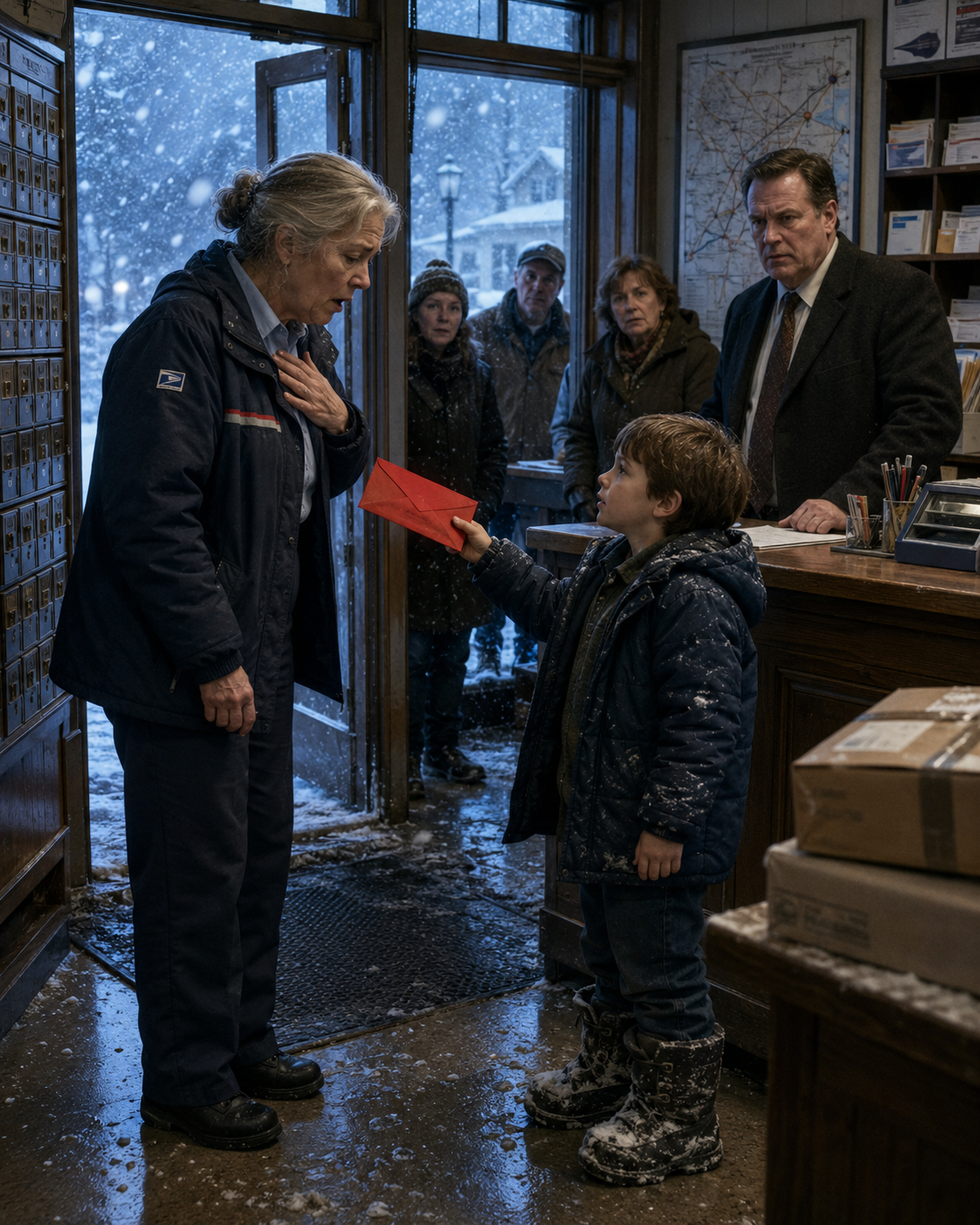
Then the front door opened.
A little boy entered carrying a red envelope.
The Boy in Snow Boots
His name was Caleb Mercer.
He was eight years old.
His snow boots were on the wrong feet.
A thin jacket hung open over his pajamas.
His face was red from the cold.
He looked around the lobby until he saw me.
“Miss Nora?”
I dropped my box of belongings.
“What happened?”
He held out the envelope.
On the front, written in blue crayon, were the words:
FOR BOX 17
Mr. Cole stepped from his office.
“Where did you get that?”
Caleb looked frightened.
I knelt in front of him.
“Tell me.”
“My grandma said to put it in the mailbox.”
“Why didn’t you?”
“The mail truck didn’t stop.”
The lobby went silent.
Caleb began to cry.
“She said red means somebody comes.”
I opened the envelope.
Inside was a card.
The handwriting shook across the paper.
NO INSULIN AFTER TONIGHT. ROAD BLOCKED. PHONE DEAD.
Caleb’s grandmother lived twelve miles beyond Cedar Ridge.
The forecast predicted heavy snow by evening.
If the road closed, she could be trapped for days.
Mr. Cole looked at the card.
“Call emergency services.”
“The county road crew has already closed Cedar Ridge,” Harold Finn said from behind us.
I had not noticed him enter.
Caleb wiped his face.
“Grandma said Miss Nora would know what to do.”
Every person in the lobby looked at Mr. Cole.
He looked at me.
For the first time, he seemed uncertain.
The Forecast Changed
The storm was supposed to arrive after midnight.
At eleven that morning, the sky darkened.
Snow began falling in thick, wet sheets.
The temperature dropped seven degrees in one hour.
Wind swept across the open fields.
The county issued an emergency travel advisory.
Then the power flickered.
Mr. Cole picked up the telephone.
No signal.
He checked his cell phone.
One bar.
Then none.
The lobby lights went out.
A backup lamp above the counter came on.
Caleb began crying again.
I stood.
“Where is the red envelope box?”
Mr. Cole frowned.
“What?”
“The envelopes you collected from Willow Road.”
“I didn’t collect any.”
My stomach tightened.
“You told the substitute carrier to stop there?”
“No. I removed the address from the route.”
“Then the cards are still in the mailbox.”
“How many?”
“I saw at least three on Wednesday.”
The wind struck the windows.
Somewhere outside, a tree branch snapped.
Harold picked up my box of belongings.
“Tell us what to do.”
The Old Map
In my truck, beneath the passenger seat, I kept a laminated map.
It showed every house on the northern route.
Not only addresses.
Wheelchair ramps.
Backup generators.
Medical conditions residents had voluntarily shared.
Homes with woodstoves.
Barns with radio equipment.
Properties where someone could operate a tractor or snowplow.
Mr. Cole stared at it.
“You maintained this yourself?”
“Daniel and I started it.”
“You stored private information in your vehicle?”
“Only what residents asked me to record.”
He pointed at a series of circles.
“What are these?”
“People who live alone.”
“And the triangles?”
“Medication-dependent.”
There were forty-three marked homes.
Mr. Cole’s face changed.
“How many of these people use the cards?”
“Thirty-one regularly. More during storms.”
The backup lights flickered.
Harold looked toward the windows.
“We need those envelopes.”
Mr. Cole picked up his coat.
“I’ll go.”
“You don’t know the road.”
“I have four-wheel drive.”
“You have never driven Willow Road in snow.”
He opened his mouth to argue.
Then Caleb took my hand.
“Please.”
Mr. Cole looked at the child.
Finally, he handed me the post-office vehicle keys.
Back to Box 17
Harold drove his repair truck.
I sat beside him.
Mr. Cole and Caleb rode behind us in the post-office SUV.
Snow covered the road faster than the plows could clear it.
By the time we reached Willow Road, visibility had dropped to less than fifty feet.
The farmhouse appeared through the storm like a shadow.
The mailbox flag was still raised.
I stepped into knee-deep snow.
Inside were seven envelopes.
Two green.
Three yellow.
One blue.
One red.
The red envelope came from Eleanor Pierce.
She lived alone in a small house near the creek.
Her note contained only four words.
SMELL GAS. FEEL DIZZY.
Harold read it.
“We go there first.”
Mr. Cole looked at the remaining envelopes.
“What about Caleb’s grandmother?”
“Yellow Road is closer to town. The fire crew may reach her from the southern side.”
“The phones are down.”
“There’s a radio at the Marlow house.”
Mr. Cole stared at the abandoned farmhouse.
“What radio?”
“The one Ruth left.”
Behind the Blue Door
The front door was locked.
The key was hidden inside an old blue birdhouse beneath the porch roof.
Edwin had put it there thirty years earlier.
Inside, the farmhouse smelled of dust, cold wood, and apples long gone.
Furniture remained beneath white sheets.
A hand-crank emergency radio sat in the pantry.
Beside it were batteries, road flares, blankets, bottled water, and a metal box filled with copies of the route map.
Mr. Cole looked around.
“This place has been empty for eleven years.”
“Not useless.”
Harold powered the radio.
Static filled the kitchen.
Then a voice answered.
The volunteer fire chief was stationed at the town garage.
Harold reported Eleanor’s gas leak and Caleb’s grandmother’s insulin shortage.
The chief sent one crew toward Cedar Ridge.
We headed toward Eleanor.
The House by the Creek
A fallen branch blocked the narrow road.
Harold used a chain to drag it aside.
The post-office SUV nearly slid into a ditch.
By the time we reached Eleanor’s house, snow had covered the porch steps.
The red card still hung from the mailbox.
I pounded on the door.
No answer.
Harold broke a side window.
The smell of gas escaped immediately.
Mr. Cole covered Caleb’s face and carried him back toward the vehicles.
Harold and I found Eleanor unconscious beside the kitchen table.
We pulled her outside.
The fire crew arrived seven minutes later.
A cracked furnace line had filled the house with gas.
The paramedic said Eleanor might not have survived another half hour.
Mr. Cole stood in the snow, staring at the red card.
No one said anything to him.
Seven Envelopes
The blue card belonged to Thomas Reed.
His heart medication would run out the following morning.
One yellow card came from a family with no heating oil.
Another came from a widow whose generator would not start.
The third came from a couple caring for an adult son who required an electric breathing machine.
The green cards came from residents who were safe.
That mattered too.
During emergencies, knowing who did not need help saved time.
For the next six hours, the farmhouse became a command post.
Volunteers arrived on snowmobiles.
A dairy farmer brought fuel.
A nurse crossed two miles on a tractor with Thomas Reed’s medication.
The high-school wrestling coach delivered insulin to Caleb’s grandmother.
Harold repaired the widow’s generator.
Mr. Cole worked the radio.
At first, he wrote everything on loose paper.
Then he found Daniel’s old storm ledger inside the metal box.
He opened it.
The first page contained my husband’s handwriting.
Nobody should disappear just because the road does.
Mr. Cole read the sentence twice.
Then he sat down.
The Name in the Ledger
Daniel and I created the system after a smaller storm in 2007.
At first, it covered nine homes.
By the winter he died, it covered twenty-six.
Afterward, I almost stopped.
Every card reminded me of the person I had failed to reach.
Ruth Marlow refused to let me quit.
“You didn’t build this because you can save everyone,” she told me.
“You built it so fewer people have to wait alone.”
So I continued.
Residents added names.
Volunteers updated the maps.
The fire department checked the radio each autumn.
No committee approved it.
No office funded it.
People simply decided to look after one another.
Until Mr. Cole removed the stop.
The Call from Cedar Ridge
At six in the evening, the radio crackled.
The fire chief’s voice came through.
Caleb’s grandmother had received her insulin.
She was safe.
Caleb leaned against me and began to cry.
Mr. Cole removed his glasses.
He wiped them even though they were not wet.
“I thought the envelopes were a habit,” he said.
“They are.”
He looked confused.
“A habit of checking.”
Outside, snow pressed against the windows.
The old farmhouse creaked in the wind.
Mr. Cole looked at the maps covering the kitchen table.
“How many times has this system been used?”
“Every winter.”
“How many emergencies?”
“I stopped counting.”
“Why was there no official record?”
“Because no one asked for one.”
He closed the ledger.
“I should have asked.”
Morning at Willow Road
The storm passed shortly before dawn.
Fourteen inches of snow covered the county.
Power remained out in most areas.
But every marked household had been checked.
No one died.
Eleanor recovered at the hospital.
Thomas received his medication.
The breathing machine continued running on a generator supplied by the dairy farm.
Caleb’s grandmother made him pancakes when he returned home.
At eight in the morning, the district supervisor arrived at 17 Willow Road in a county vehicle.
Mr. Cole had contacted her by radio.
She stepped into the farmhouse and looked at the maps, envelopes, names, and handwritten updates covering the walls.
Then she looked at me.
“Why didn’t you report this program?”
“It wasn’t a program.”
“What was it?”
I looked around the room.
“A promise.”
The Reinstatement
The district offered me my job back.
The supervisor called the termination a procedural error.
I called it a choice.
Mr. Cole stood beside her.
He did not defend himself.
“I removed the stop,” he said.
The supervisor glanced at him.
“That decision will be reviewed.”
“No.”
He looked at me.
“It should be recorded accurately. Nora explained what the envelopes were. I dismissed her.”
The room remained quiet.
“I believed anything unofficial was irresponsible,” he continued. “But I never asked why it existed.”
He removed my identification badge from his coat pocket.
“I was wrong.”
He held it out.
I did not take it immediately.
“Will Box 17 stay on the route?”
“Yes.”
“Officially?”
“Yes.”
“Will carriers be trained to recognize the cards?”
The supervisor answered.
“We will coordinate with the county.”
“And no one will be punished for stopping when a red card appears?”
“No.”
Only then did I take the badge.
A Real Program
By the following winter, the envelope system had a name.
The Willow Check-In Network
The county printed weatherproof cards.
Every rural carrier received emergency training.
Residents could choose whether to participate.
Volunteer crews updated medical and accessibility information each year.
The fire department installed a better radio at 17 Willow Road.
The farmhouse itself was repaired.
Local businesses donated lumber.
Students repainted the porch.
The wild orchard was trimmed.
A nurse stocked medical supplies in the pantry.
The old mailbox remained exactly where it had always been.
We did not replace it.
Some things earned the right to keep their scars.
Mr. Cole’s Route
Mr. Cole stayed in Fairhaven.
For a while, people were cold toward him.
Harold refused to shake his hand for almost three months.
Mrs. Larkin mailed him a thank-you card for firing me because, as she wrote:
It gave you the opportunity to learn something.
He placed it on his office wall.
The following winter, he rode my route during the first major storm.
At every mailbox, he checked for a colored card.
At Thomas Reed’s house, he found green.
At the widow’s home, green.
At Cedar Ridge, Caleb ran through the snow carrying an envelope.
Mr. Cole opened it.
Inside was a green card with a drawing of two stick figures beside a mailbox.
One wore a mailbag.
The other had square glasses.
Underneath, Caleb had written:
EVERYBODY IS SAFE
Mr. Cole folded the card carefully and placed it inside his coat.
Daniel’s Chair
When the farmhouse repairs were finished, the town placed a wooden chair beside the radio table.
It had been built from boards recovered from the old Marlow barn.
A small brass plate was attached to the back.
DANIEL VOSS
HE BELIEVED NO ROAD SHOULD END IN SILENCE
At the dedication, people expected me to give a speech.
I could not.
I placed one hand on the chair and looked at the room.
Eleanor stood near the pantry.
Thomas Reed held his granddaughter’s arm.
Caleb sat on the floor sorting colored cards.
Mr. Cole checked the radio.
For years, I believed Daniel’s last drive had ended only in loss.
But grief sometimes leaves instructions behind.
Not clearly.
Not kindly.
It teaches you where the silence is.
Then it asks what you will build there.
The Green Envelope
I retired from the postal service four years later.
On my final morning, snow covered Willow Road.
I stopped at Box 17 one last time.
There was a single green envelope inside.
No name.
No address.
I opened it.
Thirty-one signatures filled the card.
At the bottom, someone had written:
You taught us that safe is something people make for one another.
I sat inside the mail truck and cried.
Not because I was leaving.
Because for the first time, I understood that the system no longer depended on me.
That was what Daniel and I had always wanted.
Not to become heroes.
Not to be needed forever.
Only to make sure the next person knew where to look.
Before driving away, I placed one final envelope inside the old mailbox.
The card was green.
On it, I wrote:
EVERYTHING IS GREEN
Then I lowered the flag.
The farmhouse porch light came on behind me.
And even though the road disappeared into snow, no one along it was waiting alone.