
“At six in the morning, I want the $1.2 million your mother left you transferred into my son’s account.”
My mother-in-law did not say good morning.
She did not ask how I was sleeping.
She did not mention that my mother had been dead for only six months.
Selina continued as if she were reading a grocery list.
“Damien has to pay today. If he doesn’t, they’re going to destroy him.”
For several seconds, I thought I was still dreaming.
I sat alone in the kitchen of my home in Oakhaven, holding a cup of cold coffee and my phone to my ear.
Dawn was just beginning to show beyond the windows.
Upstairs, my husband slept as though nothing had happened.
“What are you talking about?” I asked.
“Don’t pretend you don’t understand, Jennifer. Jameson told us the inheritance was finalized yesterday.”
She lowered her voice.
“Your mother is gone now. That money belongs to this family.”
I ended the call without answering.
The Son Who Always Failed
Damien was Jameson’s older brother.
In five years, he had started three businesses.
Every one of them collapsed.
The first was a construction company that left workers unpaid.
The second was an investment platform that disappeared after six months.
The third was a property-development firm with no completed properties.
Damien always had an explanation.
The market changed.
His partners betrayed him.
The investors became impatient.
The employees were lazy.
He never blamed himself.
And somehow, every failure became a family emergency.
Selina refinanced her house twice for him.
Jameson lent him money from our joint savings.
Relatives stopped answering his calls.
This time, Damien owed people who were no longer willing to wait.
I did not yet know how much.
I only knew Selina believed my mother’s money should save him.
What My Mother Built
My mother, Katherine, worked for thirty-eight years as an emergency-room nurse in a public hospital.
She wore the same blue coat for nearly a decade because replacing it felt unnecessary.
She spent vacations in the backyard with borrowed novels.
She brought home bruised fruit because the supermarket sold it cheaply.
When I was a child, I watched her return from twelve-hour shifts with swollen feet.
She soaked them in a bucket of warm water while listening to every problem I had as if she had not spent the entire day caring for strangers.
She never made much money.
At least, that was what I believed.
Katherine died on a Tuesday in March after finishing a double shift.
A coworker found her collapsed in the staff hallway.
By the time I reached the hospital, she was gone.
Jameson was attentive for ten days.
Then he returned to golf.
Lunches with Damien.
Weekends away.
He was not there when I emptied my mother’s closet.
He did not answer when I found her hospital badge and broke down on the floor.
He skipped every meeting with the estate attorney.
That was why he did not know what Fiona Lockwood revealed when the estate process ended.
My mother had quietly saved and invested for decades.
She owned two small rental properties.
She held retirement accounts, bonds, and a portfolio she had built one careful deposit at a time.
The total value was almost $1.2 million.
I had no idea.
The Number on the Page
When Fiona showed me the amount, I thought about my mother’s worn shoes.
The backyard vacations.
The secondhand books.
Every time she chose something small because she was protecting something larger.
“This cannot be right,” I said.
Fiona turned the statement toward me.
“It is.”
“Why didn’t she tell me?”
“She believed money changed the way people looked at one another.”
That sounded like my mother.
Fiona studied me for a moment.
“Does your husband know?”
“No.”
“Does anyone in his family know?”
“No.”
She closed the folder.
“Then do not rush to tell them.”
I should have asked why.
Instead, I assumed she was giving ordinary legal advice.
I did not yet understand that my mother had already warned her.
They Were Waiting Inside
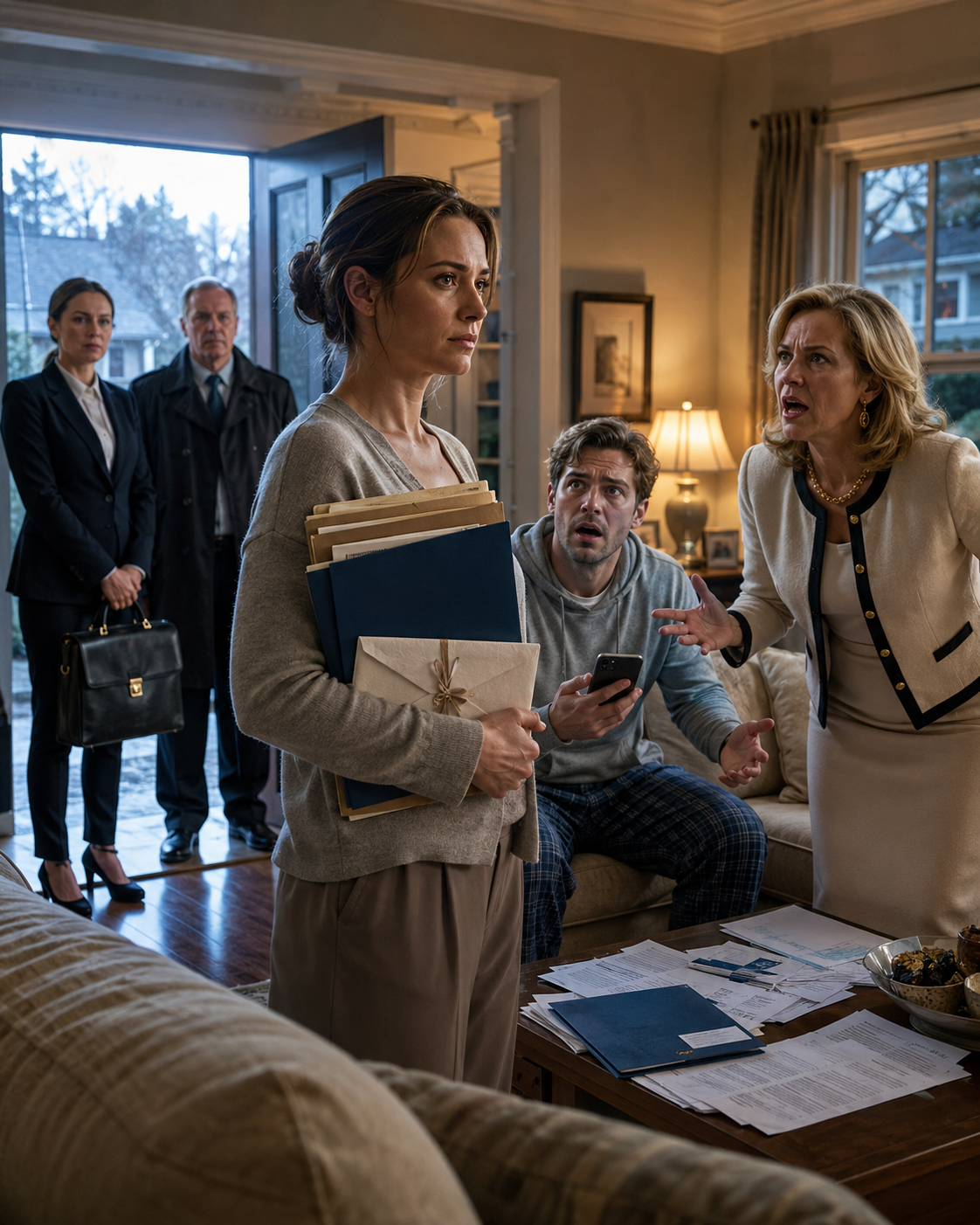
That afternoon, I returned home and found Jameson and Selina sitting in my living room.
Selina still had a key I had asked her twice to return.
An open bottle of wine sat on the coffee table.
Several pages covered with numbers were spread beside it.
Neither of them asked how I was feeling.
Jameson smiled.
“Is everything finished?”
“Yes.”
He stood and wrapped one arm around my shoulders.
It was a gesture he used whenever he wanted something.
“Perfect.”
He guided me toward the sofa.
“Damien owes about two hundred thousand dollars to several investors. We’ll pay that off first and give him enough capital to start again.”
I looked at him.
“We?”
“We’re married.”
He smiled as though I had missed something obvious.
“What’s yours is ours.”
Selina nodded.
“Your mother saved that money for you, but you belong to this family now.”
She lifted her glass.
“A good wife doesn’t let her husband’s brother fall because she’s attached to money.”
The Sentence That Changed Everything
I reminded Jameson that he had not gone with me to identify my mother’s body.
He had left me alone with every legal form.
He had never asked what item of hers I kept under my bed.
His expression hardened.
“Don’t mix your grief with a real emergency.”
That sentence settled something inside me.
I did not feel anger.
I felt clarity.
I walked to the cabinet near the dining room and removed a blue folder.
“I prepared something for this family too.”
Jameson opened it expecting bank statements.
Instead, he found an irrevocable trust agreement signed three weeks earlier.
The inheritance had been placed under independent management.
I would receive monthly distributions.
I could request funding for approved projects.
But I could not withdraw or transfer the principal.
Jameson, Selina, and Damien had no access to it.
“You did this behind my back,” he whispered.
“I protected what my mother built.”
Selina slammed her hand against the table.
“You are disloyal.”
Jameson flipped through the pages with trembling fingers.
Then I placed a second folder beside the first.
Inside was a divorce petition filed two days earlier.
But the third folder was the one that truly silenced them.
The Signature That Wasn’t Mine
The third folder contained a bank notice.
It concerned a loan secured against our house.
The application included a signature that looked exactly like mine.
I had never signed it.
Jameson stared at the page.
At that moment, someone knocked on the front door.
Three slow knocks.
Jameson’s phone began vibrating against the table.
DAMIEN CALLING
No one moved.
The phone kept ringing.
Selina looked toward the door.
“Are you expecting someone?”
“Yes.”
Jameson reached for his phone.
I stopped him.
“You should answer your brother first.”
He snatched it from the table.
“What happened?”
Damien was speaking so loudly that even Selina could hear.
“They froze the company accounts.”
Jameson turned away.
“What?”
“Two men came into the office with documents. They took the computers.”
Damien’s voice cracked.
“You said Jennifer would cooperate. You said she’d transfer the inheritance before anyone looked too closely.”
Selina stood.
“Damien, stop talking.”
There was a pause.
Then Damien said, “Mom?”
Jameson ended the call.
The knocking came again.
The Woman With the Briefcase
I opened the door.
Fiona Lockwood stood on the porch in a dark gray coat.
Beside her was a man in his late fifties wearing a navy raincoat.
“This is Elias Warren,” Fiona said. “He works with the bank’s financial-crimes department.”
Jameson stepped into the hallway.
“You brought a bank investigator into our home?”
Mr. Warren looked past him toward the table.
“Your wife reported a forged signature connected to a secured loan.”
Jameson pointed toward me.
“She’s confused. Her mother just died.”
“Six months ago,” I said.
Selina moved beside him.
“She’s still grieving.”
Mr. Warren entered.
“Grief does not usually create a forged loan agreement.”
Jameson’s jaw tightened.
“This is a family matter.”
“A loan secured against real property is a banking matter,” Mr. Warren replied.
He looked directly at Jameson.
“A falsified signature may become a criminal matter.”
The Real Number
The bank notice listed a loan of $280,000.
That number was frightening enough.
It was not the full amount.
Mr. Warren removed several documents from a sealed envelope.
“The original application requested a revolving credit line of $750,000.”
I stared at him.
“How much?”
“Seven hundred and fifty thousand.”
He placed the application on the table.
“The property was used as collateral. According to these documents, both homeowners consented.”
“I didn’t.”
“We know.”
Jameson leaned forward.
“Jennifer signed refinancing documents two years ago. The bank probably attached the wrong signature page.”
Mr. Warren placed two documents side by side.
“The signature on this application was copied from that earlier refinancing agreement.”
Even without training, I could see it.
Every letter was identical.
The same pressure marks.
The same crooked curve in the J.
A real signature never appears perfectly identical twice.
A copied one does.
“How much was taken?” I asked.
“Three hundred and forty thousand dollars.”
My knees weakened.
I sat down.
Jameson reached for me.
I moved away.
Where the Money Went
The money had not gone directly to Damien.
Jameson had been more careful than that.
First, it moved into a consulting company created four months earlier.
Then it was transferred to an account controlled by Damien’s property-development business.
From there, it was divided into smaller payments.
Some went to investors.
Some covered overdue office rent.
Some paid former employees.
Nearly thirty thousand dollars leased a new luxury SUV.
Selina stared at the statements.
“Damien told me the car belonged to a client.”
Jameson rubbed his forehead.
“He needed to look successful.”
Mr. Warren closed one file.
“Successful businesses generally do not need borrowed money to pretend they are successful.”
Selina looked at her son.
“You told me this was about keeping the company alive.”
“It was.”
“You bought him a car.”
“It was part of the image.”
She stared at him as if he were a stranger.
Why They Needed Monday
Damien did not owe only $200,000.
That was simply the amount due that morning.
His total obligations were closer to $1.8 million.
For nearly two years, he had been taking money from new investors and using part of it to repay earlier ones.
He called it temporary financing.
Jameson called it a bridge.
The bank called it suspicious movement of funds.
One investor had threatened to report Damien unless he received payment by Monday afternoon.
My inheritance was supposed to make the loudest problems disappear.
The remaining money would make Damien’s company appear healthy long enough to attract new investors.
Then, according to Jameson, everyone would eventually be repaid.
“You were going to take everything my mother left me,” I said.
“Borrow.”
“You forged my signature.”
“I was going to tell you.”
“When?”
“When Damien stabilized.”
“And if he didn’t?”
Jameson looked away.
That was the answer.
Selina’s Name
Mr. Warren turned to the final page of the loan application.
It included the signature of a witness.
Selina Hartwell
My mother-in-law lowered herself onto the sofa.
“I didn’t know what I was signing.”
Jameson turned toward her.
“Mom.”
“You told me it was permission to discuss the mortgage.”
“Do not do this.”
“You put the page in front of me and told me to sign.”
Jameson’s voice rose.
“You knew we needed the money.”
“I didn’t know Jennifer’s signature was fake.”
I watched them begin to turn on each other.
Only an hour earlier, they had spoken about loyalty.
Duty.
Family.
Now that consequences had entered the room, loyalty became blame.
The Key She Kept
Mr. Warren looked toward the key hanging from Selina’s handbag.
“How did Jameson obtain Jennifer’s earlier mortgage documents?”
Selina gripped the strap.
No one answered.
I looked at the key.
The one I had asked her twice to return.
“You came into this house.”
“I’m family.”
“You came in while I wasn’t here.”
Her mouth tightened.
“Jameson needed documents.”
“What documents?”
“The mortgage file. Tax papers.”
“And my mother’s estate letters?”
Selina said nothing.
That was how Jameson knew the inheritance had been finalized.
While I met with Fiona, Selina had entered my home and photographed the documents.
Then Jameson read my emails.
The Forwarded Messages
Fiona removed another report.
“Someone accessed Jennifer’s email from a device registered to Jameson.”
He laughed.
“We’re married. She has used my laptop.”
“The access occurred while she was meeting with me,” Fiona said. “Three messages concerning the estate were opened and forwarded.”
“To whom?” I asked.
Fiona turned the page.
“Damien.”
Jameson’s expression remained still.
But a pulse began beating in his neck.
“You read my private messages.”
“I was trying to understand what was happening.”
“You never asked.”
“You weren’t thinking clearly.”
“I was thinking clearly enough to protect the money.”
He struck the table.
“You protected it from your husband.”
“No.”
I looked at the forged loan.
“I protected it because of my husband.”
The Friend at the Bank
The loan had been approved by an assistant branch manager named Colin Vance.
Colin attended college with Damien.
He had also invested seventy-five thousand dollars in Damien’s second failed business.
Bank records showed that Colin overrode two internal warnings.
The first concerned the copied signature.
The second concerned a sudden increase in the estimated value of our house.
Damien and Jameson had submitted an altered appraisal that raised the property value by almost four hundred thousand dollars.
Colin approved the credit line anyway.
In return, Damien promised to repay his earlier investment as soon as my inheritance became available.
Mr. Warren’s team discovered the arrangement that morning.
Colin had been suspended.
His computer had been secured.
Damien’s accounts had been frozen.
The entire plan was collapsing before breakfast.
“This Can Still Be Fixed”
Jameson sat down.
“This can still be fixed.”
No one answered.
He looked at me.
“Withdraw the complaint. We can repay the bank from the trust distributions.”
“The trust will not approve payments for fraud.”
“Then dissolve it.”
“It is irrevocable.”
“You created it. You can undo it.”
Fiona shook her head.
“She cannot.”
Jameson stared at her.
Then he turned back to me.
The charm was gone.
The confidence was gone.
Underneath both was panic.
Damien’s Messages
Jameson’s phone rang again.
This time, Selina answered.
“Damien?”
His voice broke through the speaker.
“They’re saying I stole the money.”
“You did,” Selina replied.
“I was going to pay it back.”
“With Jennifer’s inheritance?”
“That was Jameson’s plan.”
Jameson stood.
“You agreed to it.”
“You told me she had already said yes.”
“You knew she hadn’t.”
“You said married couples share everything.”
It was the same sentence Jameson had used on me.
Now his brother was using it against him.
Damien continued.
“I have the messages, Jameson.”
Jameson’s face changed.
“What messages?”
“The ones where you told me to keep Mom pressuring Jennifer.”
Selina covered her mouth.
Damien kept talking.
“The ones where you said she would be too emotional after Katherine died to notice the loan.”
The room went still.
“You said grief made people easy to manage.”
Jameson lunged for the phone.
Selina stepped away.
I remembered every time he told me to rest while he handled things.
Every time he called my questions unhealthy.
Every time he said I was overwhelmed.
He had not been protecting me from stress.
He had been waiting for grief to make me easier to control.
The Box Under My Bed
“There’s something I need you to see,” I said.
I went upstairs.
Jameson tried to follow.
Fiona stepped between us.
“Let her go.”
Beneath my bed was a small metal box.
The paint was scratched.
One corner was dented.
It had belonged to my mother.
Inside were photographs, her hospital identification badge, and one sealed envelope.
Fiona had given it to me after the estate meeting.
My mother instructed her to deliver it only after everything was finalized.
I had been afraid to open it.
As long as the envelope remained sealed, there were still words from my mother I had not lost.
That morning, I carried the box downstairs.
“When the Noise Begins”
My name was written across the envelope.
For Jennifer, when the noise begins.
Selina stared at it.
“What does that mean?”
“I don’t know.”
I opened it.
Inside were four pages and a photograph.
The photograph showed my mother sitting in her backyard.
She wore the old blue coat.
A borrowed novel rested in her lap.
On the back, she had written:
A quiet life can still build something strong.
My hands trembled as I unfolded the letter.
My Jennifer,
If you are reading this, then you know about the money.
I imagine the number surprised you.
It surprised me too once it became large enough that I stopped thinking of it as savings and began thinking of it as protection.
I sat down.
No one spoke.
Why She Saved
I did not save because I wanted you to become rich.
I saved because I know what it feels like to have no choices.
When your father left, I worked through fevers, storms, holidays, and grief because missing one paycheck frightened me more than exhaustion did.
I wanted you to have the ability to leave any room where love became a demand.
I stopped reading.
Jameson stared at the floor.
My mother had understood something I had not.
Money was not only comfort.
Sometimes, it was an unlocked door.
The Questions He Asked Her
The next paragraph was about Jameson.
During my final year, Jameson began asking questions about my accounts.
He wanted to know whether my house was paid off.
He asked whether I had life insurance.
He once asked if you would inherit directly or through a trust.
Jameson shook his head.
“Those were normal questions.”
I continued.
Perhaps he was only curious.
But curiosity changes when it arrives without kindness.
He asked about the value of my life before asking how much life I had left.
Selina closed her eyes.
I did not warn you because I knew you loved him.
Warnings given too early can sound like attempts to control.
So instead, I spoke with Fiona.
I asked her to make sure you had choices.
Fiona looked at me.
“Your mother recommended the trust structure,” she said. “But she wanted the decision to remain yours.”
She had not ordered me to leave Jameson.
She had simply made sure I could.
What Money Could Not Do
I returned to the letter.
You may feel guilty when someone asks for what I left you.
Do not.
Money cannot prove love.
Giving it away cannot make an untrustworthy person safe.
Keeping it cannot make you selfish.
It is only a tool.
Use it to build a life where no one can wake you before dawn and tell you that your future belongs to them.
My throat tightened.
Keep my hospital badge.
Keep one good memory.
Release the rest when you are ready.
And please buy yourself a proper coat.
Love,
Mom
A laugh escaped me through the tears.
My mother wore the same coat for ten years.
Even at the end, she was worried about mine.
Jameson reached toward the letter.
I folded it.
“You do not get to touch this.”
What He Called Love
Jameson followed me into the hallway.
“Please listen.”
“I have listened for eight years.”
“I made a mistake.”
“A mistake is forgetting an anniversary.”
“I panicked.”
“You forged my signature.”
“For Damien.”
“You used our house.”
“I knew the inheritance was coming.”
“It was never yours.”
“We are husband and wife.”
“You filed the application while I was identifying my mother’s body.”
His expression changed.
“That is not fair.”
I stared at him.
“Not fair?”
“You’re making it sound like I planned the timing.”
The supporting documents had been uploaded the morning of my mother’s funeral.
While I stood beside her grave, Jameson had messaged Damien asking how quickly the money could be released.
That was what he had called a real emergency.
The Key on the Table
Selina remained in the living room.
The confidence had drained from her face.
“I thought we were saving Damien.”
“You were willing to destroy me to do it.”
“No.”
“You entered my home.”
“I had a key.”
“That did not mean you had permission.”
She looked at the key in her hand.
For years, Selina treated boundaries as insults.
A locked door meant rejection.
A private decision meant disloyalty.
A wife who said no was selfish.
“I raised my sons to protect each other,” she whispered.
“And who were they allowed to hurt while doing it?”
She did not answer.
Slowly, she removed the key from the ring.
She placed it on the table.
It made a small sound against the wood.
“I’m sorry.”
I believed she felt sorry.
I did not know whether she felt sorry for me or for what was about to happen to her sons.
Sometimes regret arrives before honesty.
That does not make it useless.
But it makes it incomplete.
The Official Copy
Fiona opened her briefcase.
She removed an envelope and handed it to Jameson.
“What is this?”
“Your official copy of the divorce petition.”
He looked at me.
“You planned to serve me here?”
“You planned to mortgage this house without me.”
His fingers tightened around the envelope.
“You cannot throw away eight years.”
“I’m not throwing them away.”
I looked toward my mother’s letter.
“I’m refusing to give them nine.”
Mr. Warren gathered the banking records.
“The bank will contact each of you separately.”
Jameson’s voice sharpened.
“Am I under arrest?”
“No.”
“Then I can leave.”
“Yes.”
He turned toward me.
For one second, I thought he might apologize.
Instead, he said, “You’ll regret humiliating me.”
That sentence removed the last piece of doubt.
Even then, he believed the worst thing happening was embarrassment.
Not theft.
Not betrayal.
Not the destruction of our marriage.
Humiliation.
The Golf Clubs
Jameson packed two suitcases.
He also took the golf clubs he used during the weekends my mother was dying.
Selina followed him toward the door.
Before leaving, she looked back.
“Damien may go to prison.”
“I know.”
“Jameson too.”
“I know.”
“They’re still my sons.”
“I know.”
She waited for me to say more.
I did not.
A mother’s love can explain why she is afraid.
It cannot erase what her children have done.
Selina stepped outside.
I closed the door.
Then I locked it.
The sound was softer than I expected.
The Slow Consequences
The investigation lasted fourteen months.
Damien’s company collapsed during the first week.
Investors filed claims.
The luxury SUV was repossessed.
The office furniture was sold.
Former employees provided records showing that Damien had continued paying himself while telling them the company had no money.
Colin Vance admitted that he ignored the bank’s warnings.
He gave investigators messages, loan drafts, and records of meetings with Damien and Jameson.
Damien pleaded guilty to fraud and related financial offenses.
He received a prison sentence and was ordered to pay restitution.
Jameson was charged separately for his role in the forged loan and unauthorized access to my accounts.
His attorney argued that he believed marriage gave him authority over the property.
The records proved otherwise.
He accepted a plea agreement.
There was no dramatic courtroom speech.
No applause.
Only a judge asking whether he understood that marriage did not make another person’s identity his property.
Jameson said yes.
I wondered whether he finally understood.
Leaving the House
The bank confirmed the signature was forged.
The credit line was canceled.
The lien was removed.
I was not responsible for the stolen money.
But keeping the house felt wrong.
Every room held something I wanted to leave behind.
The kitchen where Selina demanded my inheritance.
The living room where Jameson explained that Damien’s emergency mattered more than my grief.
The staircase where I waited for him to comfort me after I found my mother’s badge.
He never did.
Six months after the divorce was finalized, I sold the house.
Jameson learned through his attorney.
By then, permission was no longer confused with loyalty.
Katherine’s Room
The trust gave me monthly distributions.
It also allowed funding for approved projects.
My first proposal went to my mother’s hospital.
The staff room beside the emergency department had cracked chairs, gray walls, and a refrigerator that barely worked.
Nurses ate standing beside paperwork.
Some slept for ten minutes with their heads against lockers.
My proposal paid for a complete renovation.
Comfortable chairs.
Lockers.
Healthy food available at all hours.
A shower for employees unable to go home between emergencies.
A small library.
Near the window, we created a quiet corner with a folding table and shelves filled with donated novels.
I named it Katherine’s Room.
The hospital suggested hanging a large photograph of my mother.
I refused.
She would have hated it.
Instead, I framed her hospital badge.
Beneath it was a small plaque:
For those who care for everyone and still deserve a place to rest.
The Nurse Without Shoes
On opening day, I stood near the back while nurses entered.
One sat down and immediately closed her eyes.
Another removed her shoes and stretched her feet onto a stool.
A third picked up a novel.
For a moment, I saw my mother in all of them.
Swollen feet.
Tired eyes.
Someone else’s emergency still clinging to her clothes.
Fiona stood beside me.
“She would be proud.”
“I hope so.”
“She was.”
I looked at her.
Fiona smiled.
“She talked about you constantly.”
That should have made me cry.
Instead, it felt warm.
Like hearing my mother’s voice from another room.
Selina’s Letter
Two years after that morning, a letter arrived from Selina.
She had moved into a smaller apartment.
She worked part-time at a community food pantry.
Damien had stopped blaming everyone else, though she did not know whether the change would last.
Jameson had begun counseling as part of his probation.
He asked her to contact me.
She refused.
That surprised me.
Near the end, she wrote:
I taught my sons that family meant never saying no to each other.
I understand now that I taught them loyalty without conscience.
That was not love.
It was permission.
She did not ask for forgiveness.
She did not ask for money.
Inside the envelope was the old house key.
The same one she had placed on my table.
I held it for a long time.
Then I put it inside my mother’s metal box beside her hospital badge.
Not because it still opened anything.
Because it no longer did.
A Proper Coat
That winter, the temperature fell below freezing.
I was leaving Katherine’s Room after delivering a box of books when one of the nurses stopped me.
“Jennifer, your coat is torn.”
I looked down.
The lining had separated near the pocket.
For months, I had ignored it.
I heard my mother’s final instruction.
Please buy yourself a proper coat.
So I did.
Nothing extravagant.
A dark blue wool coat with deep pockets and a warm collar.
The first morning I wore it, I walked through Oakhaven before sunrise.
The hospital windows glowed across the street.
Somewhere inside, nurses were beginning another shift.
Others were finishing one.
I bought coffee and sat on a bench.
It slowly grew cold in my hands.
But this time, no one called to tell me what belonged to them.
No one demanded that I surrender what my mother had built.
The city woke around me.
I touched the folded letter inside my coat pocket.
My mother had spent her life creating a future she never intended to control.
She did not leave me $1.2 million so I could rescue people who refused to stop falling.
She left it so I would never have to fall with them.
And as the sun rose over the hospital where she had worked for thirty-eight years, I finally understood the difference between being given money and being given a way out.