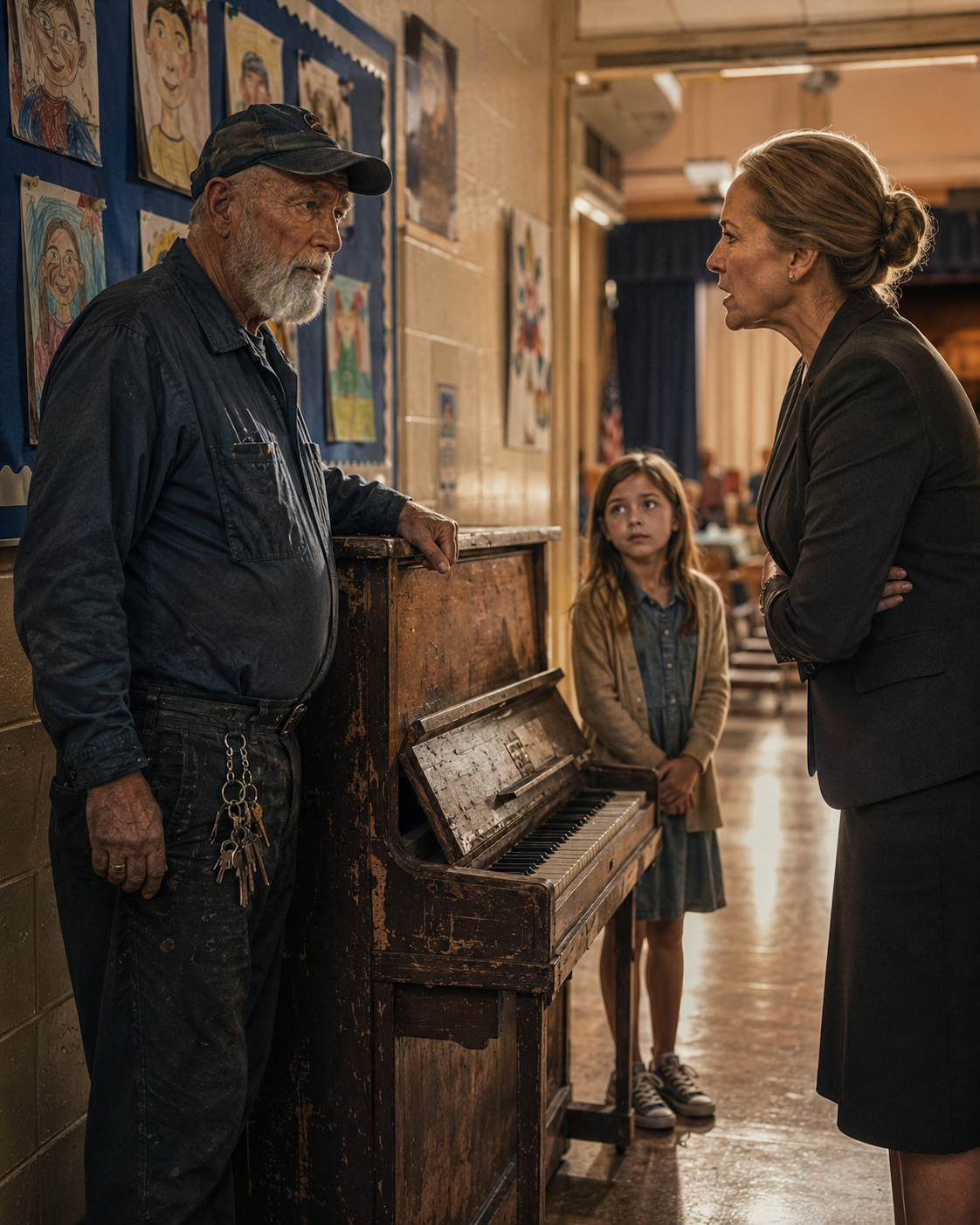
The principal told Mr. Bell to drag the broken piano to the dumpster before the parents arrived.
He placed both hands on the scratched wooden lid and said, “No.”
In twelve years at Maple Ridge Elementary, I had never heard our janitor refuse an order.
He was the quietest man in the building.
He arrived before sunrise.
He emptied trash cans.
He fixed leaking faucets.
He disappeared into the boiler room whenever teachers gathered in the hallway.
Most students knew him only as the tall man with the silver beard who carried a ring of keys on his belt.
But that morning, with the old piano between him and Principal Hayes, Mr. Bell looked like a different person.
“That thing is ruined,” the principal said.
Mr. Bell looked down at the chipped keys.
“Not ruined.”
“Half the notes don’t work.”
“They can be repaired.”
“We don’t have money to repair it.”
Mr. Bell ran one finger across the faded wood.
“Then give me a week.”
Principal Hayes sighed.
“We have the spring showcase next Friday. Parents will be walking through this hallway. I’m not leaving a broken piano beside the auditorium.”
Mr. Bell looked toward the double doors.
Then he said something none of us understood.
“She waited twenty-seven years to come back.”
The Forgotten Piano
The piano had appeared three days earlier.
No one knew who donated it.
A moving truck delivered it before school, along with a small envelope addressed simply to:
MAPLE RIDGE MUSIC PROGRAM
There was no return address.
Inside the envelope was a handwritten note.
Please let a child play this again.
Our music teacher, Mrs. Patel, tried every key.
Sixteen made no sound.
Three stuck when pressed.
The pedal squealed.
One leg had been reinforced with a block of unfinished wood.
“It would cost more to restore than it’s worth,” she told Principal Hayes.
That settled the matter.
Our school had already cut art supplies, after-school tutoring, and two field trips.
A piano that barely worked was not a priority.
Principal Hayes instructed Mr. Bell to remove it.
That should have been the end of the story.
But Mr. Bell stood in front of the piano like a guard.
“I’ll repair it after my shift,” he said.
“With what?”
“My tools.”
“You repair sinks, Samuel.”
Mr. Bell met the principal’s eyes.
“I know more than sinks.”
A Strange Request
Principal Hayes gave him seven days.
He made it clear that the school would not pay for materials or overtime.
“If it isn’t playable by Thursday evening, it goes,” he said.
Mr. Bell nodded.
Then he asked me for a favor.
I taught fourth-grade language arts across the hall from the auditorium.
“Could you keep the children away from this area after dismissal?” he asked.
“Why?”
“Some repairs need quiet.”
That afternoon, I stayed late grading papers.
At five-thirty, I heard the first sound.
Not music.
A single note.
Then another.
Then silence.
I stepped into the hallway.
The piano’s front panel had been removed.
Small tools were arranged neatly on a white cloth.
Mr. Bell sat on a wooden stool, leaning into the instrument with a flashlight between his teeth.
“You really know how to fix this?”
He removed the flashlight.
“I used to.”
“Used to what?”
Instead of answering, he pressed one of the broken keys.
Nothing happened.
He adjusted something inside.
Then he pressed it again.
A clear note rang through the empty hallway.
Mr. Bell closed his eyes.
For just a moment, he looked relieved.
Then the note faded.
The Girl at the Door
The next morning, one of my students was waiting outside the auditorium.
Her name was Lena Morales.
She was nine years old and rarely spoke above a whisper.
Lena’s family had moved into the district after a fire destroyed their apartment building.
She had lost nearly everything.
Her clothes.
Her books.
The stuffed rabbit she had slept with since she was three.
Her mother told me Lena had stopped playing with other children after the fire.
At recess, she sat beneath the oak tree and drew houses.
Always houses.
Some had smoke above them.
Some had no doors.
That morning, Lena crouched beside the piano.
Mr. Bell was tightening a screw beneath the keyboard.
“Can you play it?” she asked.
He looked surprised.
“No.”
“You fixed a note yesterday.”
“How do you know?”
“I heard it.”
Mr. Bell glanced toward me.
I raised my hands.
“She came early.”
Lena pressed one working key.
Then another.
The notes did not form a melody.
She looked at Mr. Bell.
“Will it remember songs when it’s fixed?”
He froze.
“What do you mean?”
“My mother said pianos remember every person who plays them.”
Mr. Bell looked toward the open instrument.
Then he said, “Your mother may be right.”
What She Found
On the third day, Lena discovered a folded sheet of paper inside the piano bench.
It was hidden beneath a torn piece of red fabric.
The paper had yellowed around the edges.
Music notes covered both sides.
At the top, written in blue ink, were four words:
For Anna, When Ready
Lena carried it to Mrs. Patel.
“Is it a song?”
Mrs. Patel studied the pages.
“Part of one.”
“Can you play it?”
“I can try.”
She placed the music above the keyboard.
The first several measures were soft and simple.
Then the notes became more complex.
Halfway down the second page, the music stopped.
There was no ending.
Mrs. Patel played the opening on the few working keys.
Mr. Bell entered the hallway carrying a mop bucket.
The moment he heard the melody, he stopped walking.
The bucket slipped from his hand.
Water spilled across the floor.
The Name Anna
Mrs. Patel turned.
“Samuel?”
Mr. Bell did not respond.
His face had gone pale.
Lena held up the music.
“Do you know this song?”
Mr. Bell looked at the handwriting.
His knees seemed to weaken.
He sat on the nearest chair.
“Where did you find that?”
“In the bench.”
He took the paper carefully, holding it by the edges.
His hands trembled.
Mrs. Patel crouched beside him.
“Who is Anna?”
For several seconds, Mr. Bell stared at the unfinished music.
Then he folded it along the old crease.
“My daughter.”
No one spoke.
Most of us did not know Mr. Bell had ever been married.
None of us knew he had a child.
Before the Keys
Long before he became Maple Ridge’s janitor, Samuel Bell had been a pianist.
Not a hobbyist.
Not someone who played hymns on weekends.
He had studied at a conservatory in Boston.
He performed with regional orchestras.
His photograph once appeared in arts magazines.
Mrs. Patel searched his name that evening and found an old newspaper article.
The photograph showed a young man with dark hair sitting at a concert grand piano.
The caption read:
SAMUEL BELL, RISING AMERICAN COMPOSER, PREMIERES NEW WORK
I stared at the picture for a long time.
It was Mr. Bell.
But the expression was unfamiliar.
He was smiling.
The article said his wife, Elise, was a violinist.
Their seven-year-old daughter, Anna, had recently begun composing small melodies with him.
Then the articles stopped.
There were no later performances.
No interviews.
No explanation.
Only silence.
The Winter Concert
Mr. Bell told us the rest the following afternoon.
He sat beside the broken piano while Lena listened from the floor.
“Anna loved making up songs,” he said.
“She couldn’t write music yet, so she would sing a melody and I would write it down.”
The unfinished piece was the last song they created together.
Anna called it The House With Yellow Windows.
She imagined a home where every room stayed warm, even in winter.
Mr. Bell planned to surprise her by arranging it for piano and violin.
He wrote the words For Anna, When Ready at the top.
The family was supposed to perform it at a small winter concert.
They never did.
Two weeks before the performance, Elise and Anna were driving home from rehearsal.
Snow covered the highway.
A truck lost control.
Elise died at the scene.
Anna survived for three days.
Mr. Bell sat beside her in the hospital.
She never regained consciousness.
After the funeral, he closed the piano and never played again.
Twenty-Seven Years
The piano had belonged to Elise’s sister.
After the accident, Mr. Bell gave it to her because he could not bear to keep it.
They lost contact over the years.
He did not know she had moved.
He did not know she had died.
But the donated piano was the same one.
He recognized the reinforced leg.
He had repaired it himself when Anna tried to climb onto the keyboard at age four.
“She came back,” he said softly.
Lena looked confused.
“The piano?”
Mr. Bell nodded.
“The piano.”
“And the song.”
He looked at the folded pages.
“Yes.”
Lena sat beside him.
“Maybe it came back because it wants an ending.”
Mr. Bell closed his eyes.
“No.”
“Why not?”
“Some songs should remain unfinished.”
Lena thought about this.
Then she asked, “Because finishing it would mean she’s gone?”
Mr. Bell opened his eyes.
No adult in the room moved.
Lena picked at a loose thread on her sleeve.
“My house burned down,” she said. “My mother says we have to start over.”
Mr. Bell lowered his gaze.
“Do you want to?”
“No.”
“Neither did I.”
The Missing Note
By Wednesday, Mr. Bell had repaired nearly every key.
He replaced worn felt with scraps donated by a local upholstery shop.
He cleaned the strings.
He reshaped small wooden parts by hand.
He stayed until nearly midnight.
Only one note remained broken.
Middle C.
Mrs. Patel said it was the note young students used to find their place on the keyboard.
Without it, beginner lessons would be difficult.
Mr. Bell removed the key and examined the mechanism.
A small object was wedged beneath the action.
He reached inside with a pair of tweezers.
It was a yellow plastic star.
Faded.
Scratched.
A child’s sticker.
Mr. Bell stared at it.
Then he laughed.
It was a small sound, almost like a cough.
“Anna put these on everything,” he said.
Lena leaned closer.
“Even inside pianos?”
“Apparently.”
Mr. Bell placed the star in his shirt pocket.
Then he repaired Middle C.
When he pressed it, the note rang clear and strong.
The Showcase Problem
On Thursday morning, Principal Hayes inspected the piano.
Every key worked.
The pedal no longer squealed.
The wood had been polished, though the scratches remained.
“You did it,” he said.
Mr. Bell stood beside the instrument.
“Yes.”
Principal Hayes tested three notes.
“Mrs. Patel can use it during the showcase.”
Mr. Bell immediately shook his head.
“No.”
The principal frowned.
“You repaired it for the music program.”
“I repaired it so children could play.”
“That is the music program.”
“Not Friday night.”
Principal Hayes looked at him impatiently.
“What happens Friday night?”
Mr. Bell did not answer.
Lena did.
“He’s scared.”
The principal glanced down at her.
“Lena.”
“He can fix the piano,” she continued, “but he’s scared to play it.”
Mr. Bell picked up his toolbox.
“I have work to do.”
He walked away.
The Secret Rehearsal
That afternoon, Lena asked Mrs. Patel to teach her The House With Yellow Windows.
“There isn’t an ending,” Mrs. Patel reminded her.
“Then teach me the beginning.”
Lena had never taken a piano lesson.
Her fingers were stiff.
She pressed too hard.
She forgot which notes came next.
But she returned before school every morning.
She practiced during lunch.
She stayed after dismissal while her mother worked across town.
Mr. Bell pretended not to watch.
He changed lightbulbs in the hallway.
He polished the floor near the auditorium.
He repaired the same loose cabinet handle three times.
Whenever Lena made a mistake, he paused.
Whenever she found the correct notes, he continued working.
On Tuesday, Lena reached the unfinished measure.
She lifted her hands.
“What happens next?”
Mrs. Patel shook her head.
“Only Mr. Bell knows.”
He was standing twenty feet away.
Lena turned on the bench.
“What happens next?”
He looked at the floor.
“I never wrote it.”
“But you heard it.”
Mr. Bell did not reply.
“You heard Anna sing it,” Lena said.
His grip tightened around the broom.
“Yes.”
“Then you know.”
The First Lesson
Mr. Bell sat beside Lena.
He had avoided the bench for twenty-seven years.
When he lowered himself onto it, his entire body seemed to tense.
He placed his hands above the keys.
Then pulled them back.
Lena waited.
No one hurried him.
Finally, he pressed Middle C.
One note.
Then another.
The melody began where the written page ended.
It was gentle.
Uncertain.
The kind of music that seemed to search for its next step.
Lena watched his hands.
“Again,” she whispered.
He played the missing measures.
This time, she joined him with one finger.
Then two.
By the fourth attempt, she could follow the melody.
Mr. Bell wrote the new notes onto blank paper.
At the final measure, his pencil stopped.
“What’s wrong?” Lena asked.
“I don’t remember the last chord.”
“Make a new one.”
“It was her song.”
“She started it,” Lena said. “You’re still here.”
Mr. Bell stared at her.
Then he wrote the final chord.
Friday Night
The spring showcase filled the auditorium.
Parents crowded into folding chairs.
Children displayed paintings, science projects, poems, and model bridges.
The old piano stood beneath one spotlight.
Principal Hayes had added Musical Performance to the program.
Mrs. Patel was supposed to play.
But when the curtain opened, Lena walked onto the stage alone.
A murmur moved through the audience.
She wore a yellow dress borrowed from her cousin.
Her mother sat in the front row, one hand covering her mouth.
Lena sat at the piano.
She looked toward the side curtain.
Mr. Bell stood in the shadows wearing his gray work uniform.
He shook his head.
Lena turned back to the audience.
“My name is Lena Morales,” she said.
Her voice trembled through the microphone.
“This song was written by a girl named Anna Bell.”
Mr. Bell closed his eyes.
“She didn’t get to finish it,” Lena continued. “So her father helped.”
Every person in the auditorium turned toward the curtain.
Mr. Bell did not move.
Lena placed her hands on the keys.
Then she began.
The Wrong Notes
The first measures were quiet.
Lena missed the fifth note.
She paused.
Someone in the audience coughed.
She tried again.
This time, her left hand slipped.
The melody broke apart.
Lena stared at the keyboard.
Her shoulders began to shake.
Mrs. Patel took one step toward the stage.
But before she reached it, Mr. Bell walked out from behind the curtain.
He crossed the stage slowly.
The audience became silent.
Lena wiped her face.
“I ruined it.”
Mr. Bell sat beside her.
“No,” he said. “You found where it needs help.”
He placed his hands on the keys.
The room held its breath.
When He Played
The first chord filled the auditorium.
It was deeper than I expected.
Not louder.
Deeper.
As though the sound had been trapped inside the piano for decades and had finally found a door.
Mr. Bell played the opening alone.
Then he nodded to Lena.
She joined him.
Her small fingers followed the simple notes Anna had created as a child.
His hands carried the harmony beneath them.
The melody rose.
It sounded warm.
Then sad.
Then hopeful in a way that hurt.
Halfway through, Mr. Bell looked toward the empty chair beside the stage.
I do not know what he saw.
A seven-year-old girl singing?
His wife holding a violin?
A house with yellow windows?
Whatever it was, tears ran into his beard.
He did not stop playing.
The Last Chord
When they reached the unwritten ending, Lena hesitated.
Mr. Bell whispered, “Keep going.”
Together, they played the final measures.
Then came the chord he had written only days earlier.
It was not triumphant.
It did not sound like grief disappearing.
It sounded like a door opening into another room.
The last note faded.
No one applauded at first.
The auditorium was completely still.
Then Lena’s mother stood.
Mrs. Patel stood beside her.
I rose.
Within seconds, every person in the room was standing.
The applause seemed to shake the walls.
Mr. Bell looked frightened by it.
Lena reached for his hand.
He looked down at her.
Then he stood and bowed.
What Came After
The video spread through town.
A parent posted it online.
Former musicians recognized Mr. Bell’s name.
A local arts foundation offered to pay for the piano’s full restoration.
The newspaper asked him for an interview.
He declined.
A concert hall invited him to perform.
He declined that too.
But he accepted one offer.
Maple Ridge created a free after-school piano program.
Mr. Bell taught beginners every Tuesday and Thursday.
He insisted that every student learn how to open the front panel and understand how the instrument worked.
“Music isn’t magic,” he told them. “It’s hundreds of small pieces agreeing to move together.”
Lena became his first student.
She still drew houses during recess.
But slowly, they changed.
The smoke disappeared.
Doors appeared.
Then curtains.
Then small yellow windows.
The New Bench
At the end of the school year, Mr. Bell built a new piano bench.
He used wood from a maple tree that had fallen behind the playground.
On the inside of the lid, he attached a small brass plate.
It read:
FOR ANNA, WHEN READY
Beneath it, he added a second line.
FOR EVERY CHILD AFTER HER
He placed the faded yellow star beside the plaque.
Lena watched him close the lid.
“Do pianos really remember everyone who plays them?” she asked.
Mr. Bell thought for a moment.
“No.”
She looked disappointed.
Then he smiled.
“But people do.”
The Yellow Windows
Three years later, Lena performed The House With Yellow Windows at the district music festival.
Mr. Bell sat in the front row.
He wore a dark suit instead of his work uniform.
His silver beard had grown shorter.
His hands rested quietly on his knees.
Lena played the piece alone.
She did not miss a note.
When she reached the final chord, she looked toward him.
Mr. Bell nodded.
After the performance, Lena handed him a drawing.
It showed a small house beneath a blue sky.
Every window was yellow.
A woman stood outside holding a violin.
A little girl sat at a piano.
And beside them stood an older man with a ring of keys on his belt.
Mr. Bell studied the drawing for a long time.
Then he folded it carefully and placed it in his coat pocket.
The old piano still stands outside the Maple Ridge auditorium.
Its wood is scratched.
One leg is slightly uneven.
And if you lift the lid of the bench, you can see a faded yellow star beneath two engraved names.
People sometimes call it the piano Mr. Bell saved.
But that is not quite true.
He repaired the keys.
Lena finished the song.
And somewhere between the first broken note and the last chord, the piano saved both of them.